Al Search Weekly - Week 50 of 2025: Reuters further solidifying it's leading position, with Wikipedia on a slight decline
Al Search Weekly - Week 50 of 2025: Reuters further solidifying it's leading position, with Wikipedia on a slight decline
Reuters further solidifying it's leading position, with Wikipedia on a slight decline. Plus, we are introducing week on week comparisons.

ALLMO.ai Team
ALLMO.ai Team
Dec 8, 2025
Dec 8, 2025
As artificial intelligence search platforms continue to evolve, understanding citation patterns becomes increasingly critical for publishers navigating this new information ecosystem. This week's analysis examines how Reuters, Wikipedia, YouTube, and other major sources perform across ChatGPT-4, ChatGPT-5, and Perplexity, revealing both consistent patterns and notable shifts in source selection behavior.
This analysis draws from ALLMO.ai's comprehensive tracking methodology, which tests AI search platforms using diverse prompts spanning news topics, autocomplete suggestions, and category-specific queries. By examining which sources these platforms cite most frequently, publishers can better understand their visibility in AI-generated responses. See the full data at allmo.ai/trends.
New: For the first time this report also includes week-to-week variations may reflect current news cycles, platform algorithm adjustments, or shifting content availability rather than permanent structural changes in citation behavior. Still the data reflects a limited time period of citation patterns and should be interpreted within that temporal context.
Top 3 Highlights
1. Reuters Increases Dominance in Economics & Finance
Reuters leads economics and finance citations at 51.6% (↑ from 43.3%), maintaining its position as the primary financial news source across AI platforms. This 8-percentage-point increase represents substantial growth in an already dominant position, reflecting the platform's continued reliance on established wire services for economic information.
2. Wikipedia Shows Modest Decline Across Categories
Wikipedia citations decreased to 16.1% in economics (↓ from 23.3%) and 17.9% in sports (↓ from 32.4%), while maintaining 38.1% in general news (↓ from 40.2%). These declines of 7-14 percentage points suggest AI platforms may be shifting toward more specialized primary sources, though Wikipedia remains a significant reference across most categories.
3. Technology Coverage Shows Specialized Source Concentration
TechCrunch maintains strong presence at 26.9% in technology coverage (↑ from 23.1%), while specialist sources including TechStartups (15.4%) and Crunchbase (13.5%) capture substantial citation share. This pattern indicates technology queries favor vertical-specific publishers over general news sources.
Overall Platform Leaders
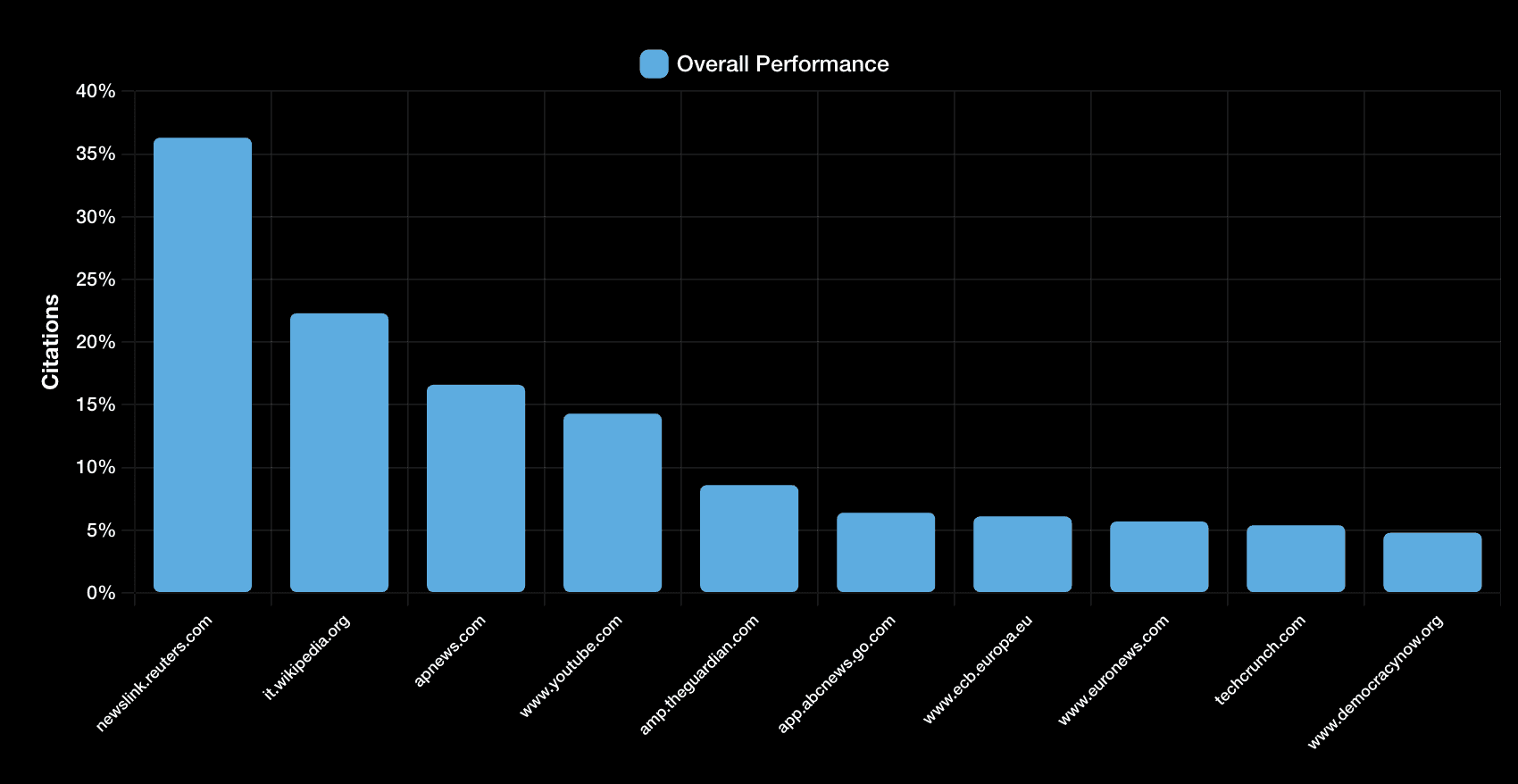
This section examines the top-cited sources across all platforms and categories, providing insight into which publishers maintain the strongest overall visibility in AI search results.
Reuters and Wikipedia Lead Overall Citations
Reuters captures 51.6% of economics citations, 41.7% in general news, 30.8% in sports, and 23.1% in technology, demonstrating consistent cross-category strength.
Wikipedia shows broad presence with 38.1% in general news, 17.9% in sports, 16.1% in economics, and 9.6% in technology, maintaining its role as a foundational reference source.
YouTube reaches 21.4% in general news citations (↓ from 24.4%), 12.8% in sports (↓ from 18.9%), and 9.7% in economics (↑ from 3.3%), showing category-specific video content preferences.
AP News maintains 22.6% citation rate in both economics and general news (↑ from 14.1% overall), entering the top performers this week with substantial gains.
The Guardian appears at 11.9% in general news citations (↑ from 8.4% overall), increasing its presence among top-cited sources.
Key Takeaway: The data shows Reuters strengthening its position across most categories while Wikipedia experiences moderate declines, particularly in specialized topics. YouTube's presence varies significantly by category, suggesting video content serves specific query types rather than universal information needs. The rise of AP News into top citations indicates week-over-week volatility in secondary news sources, likely reflecting recent news cycles that favor wire service reporting.
Category Analysis: Economics & Finance
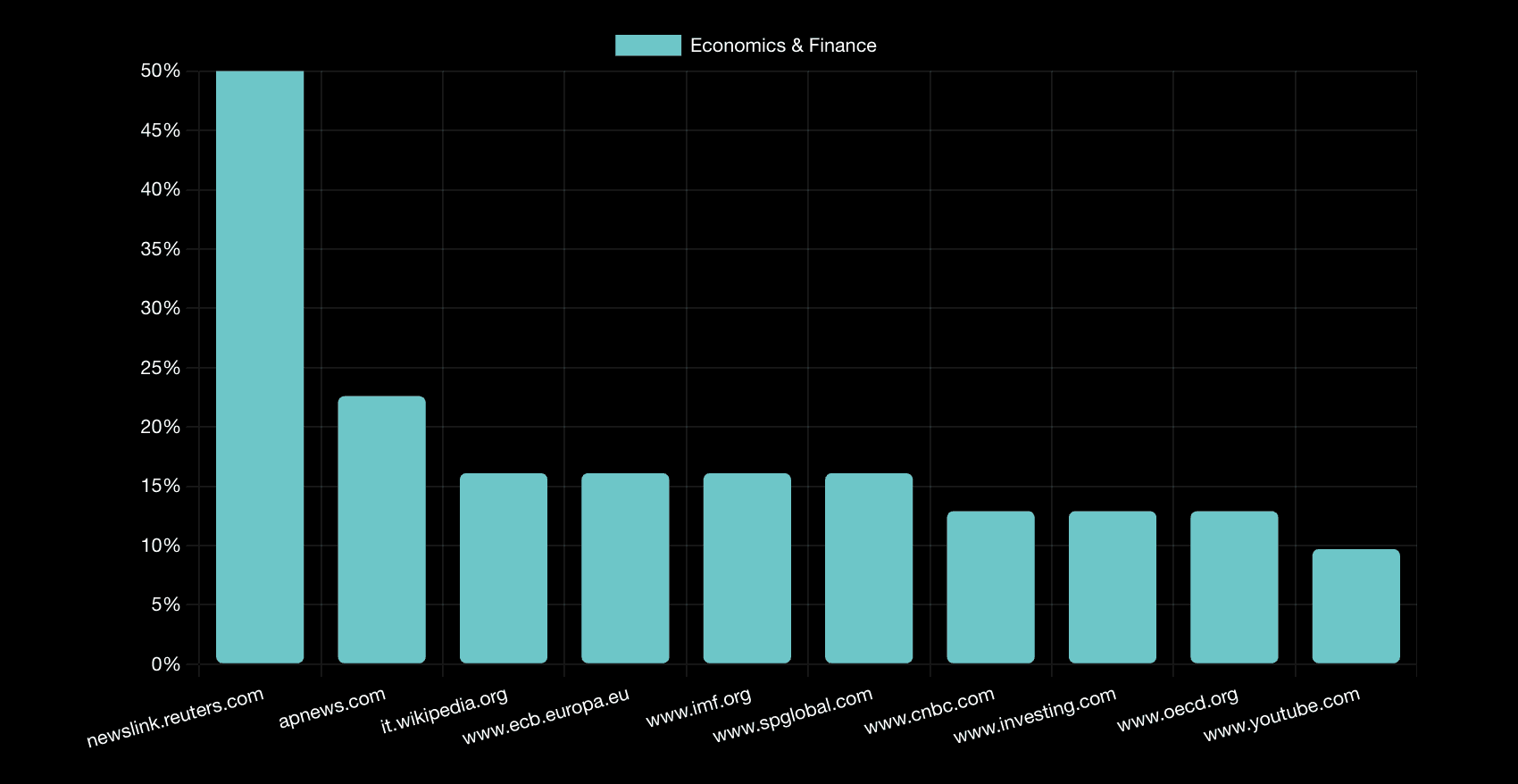
Economic and financial queries show distinct citation patterns, with institutional sources and specialized financial publishers commanding significant visibility alongside major news outlets.
Institutional and Wire Service Dominance
Reuters leads with 51.6% (↑ from 43.3%), representing more than half of all top citations in economic queries and showing 8-percentage-point growth.
AP News captures 22.6% (↑ from previous week's absence from top 10), marking a new entry to top performers in this category.
European Central Bank maintains 16.1% (↓ from 20.0%), IMF holds 16.1% (↓ from 20.0%), and S&P Global shows 16.1% (↓ from 20.0%), all demonstrating institutional source authority despite modest declines.
CNBC appears at 12.9%, Investing.com at 12.9%, and OECD at 12.9%, indicating distributed citation patterns among specialized financial sources.
Wikipedia's presence at 16.1% (↓ from 23.3%) represents a 7-percentage-point decline, suggesting reduced reliance on encyclopedia sources for economic information.
Key Takeaway: Economics and finance queries demonstrate high concentration among wire services and institutional sources, with Reuters capturing more than half of top citations. The notable presence of organizations like the ECB, IMF, and OECD indicates AI platforms prioritize authoritative institutional voices for economic data and analysis. The increase in Reuters and AP News, combined with Wikipedia's decline, suggests a shift toward primary news sources over reference material for financial topics this week, though this may reflect recent economic news cycles rather than permanent pattern changes.
Category Analysis: Start-ups & Technology
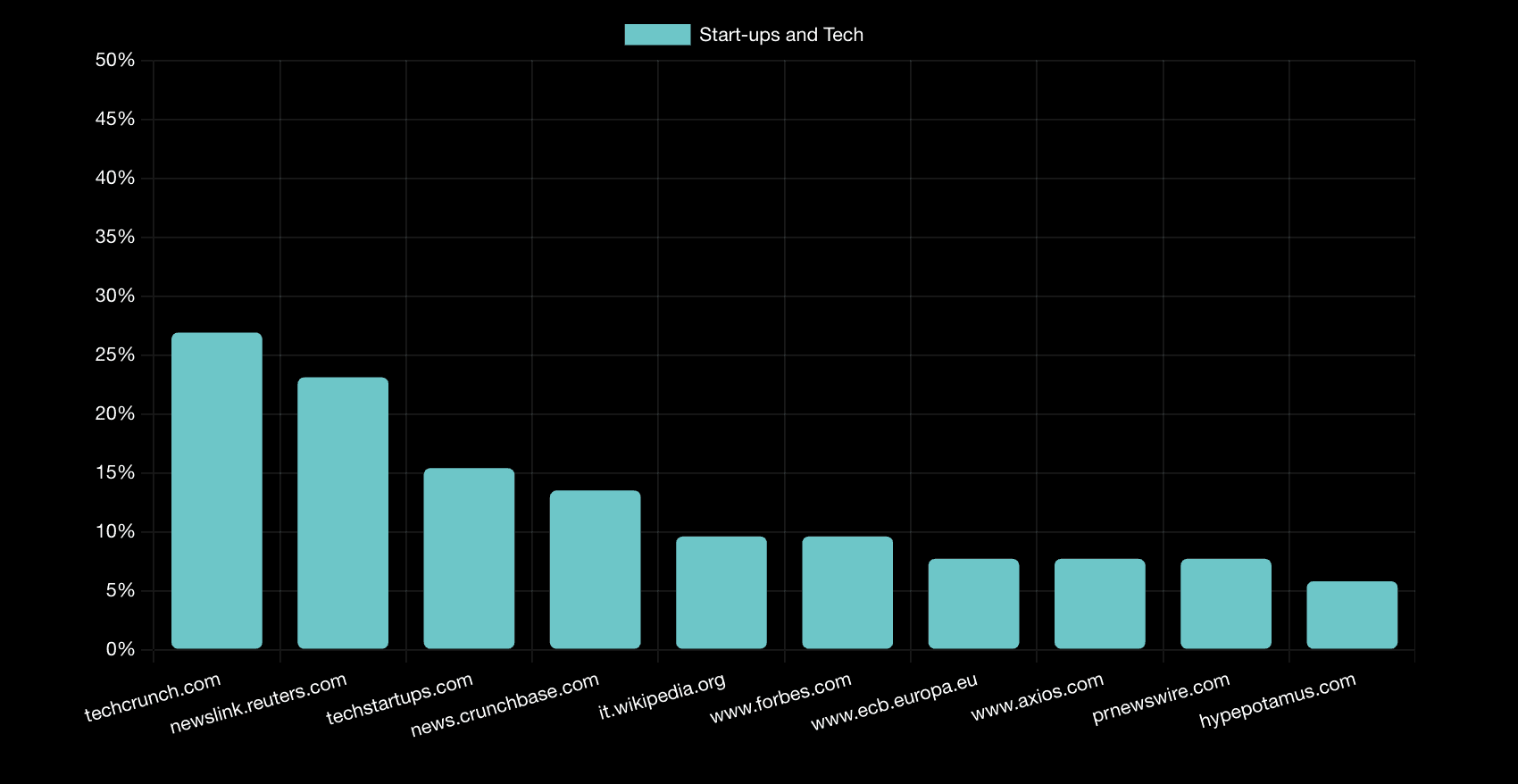
Technology and startup coverage reveals strong specialization dynamics, with vertical-specific publishers capturing substantial citation share alongside general business sources.
Specialist Technology Publishers Lead
TechCrunch dominates with 26.9% (↑ from 23.1%), maintaining its position as the leading technology news source and showing continued growth.
Reuters captures 23.1% (↑ from 21.2%), demonstrating wire service relevance even in specialized technology coverage.
TechStartups reaches 15.4%, representing a new entry to top performers this week, while Crunchbase maintains 13.5% (↑ from 11.5%).
Forbes shows 9.6% (unchanged from previous week), Wikipedia at 9.6% (unchanged), and Axios at 7.7% (↓ from 9.6%), indicating distributed secondary source citations.
PR Newswire appears at 7.7%, reflecting the role of press releases in startup coverage, while Hypepotamus captures 5.8% as a regional technology source.
Key Takeaway: Technology queries favor specialized vertical publishers, with TechCrunch capturing more than a quarter of top citations. The presence of multiple startup-focused sources (TechStartups, Crunchbase) alongside general business publishers suggests AI platforms recognize technology coverage requires domain expertise. The relatively lower presence of Wikipedia (9.6%) compared to general news (38.1%) indicates technology queries prioritize current industry news over reference material.
Category Analysis: Sports
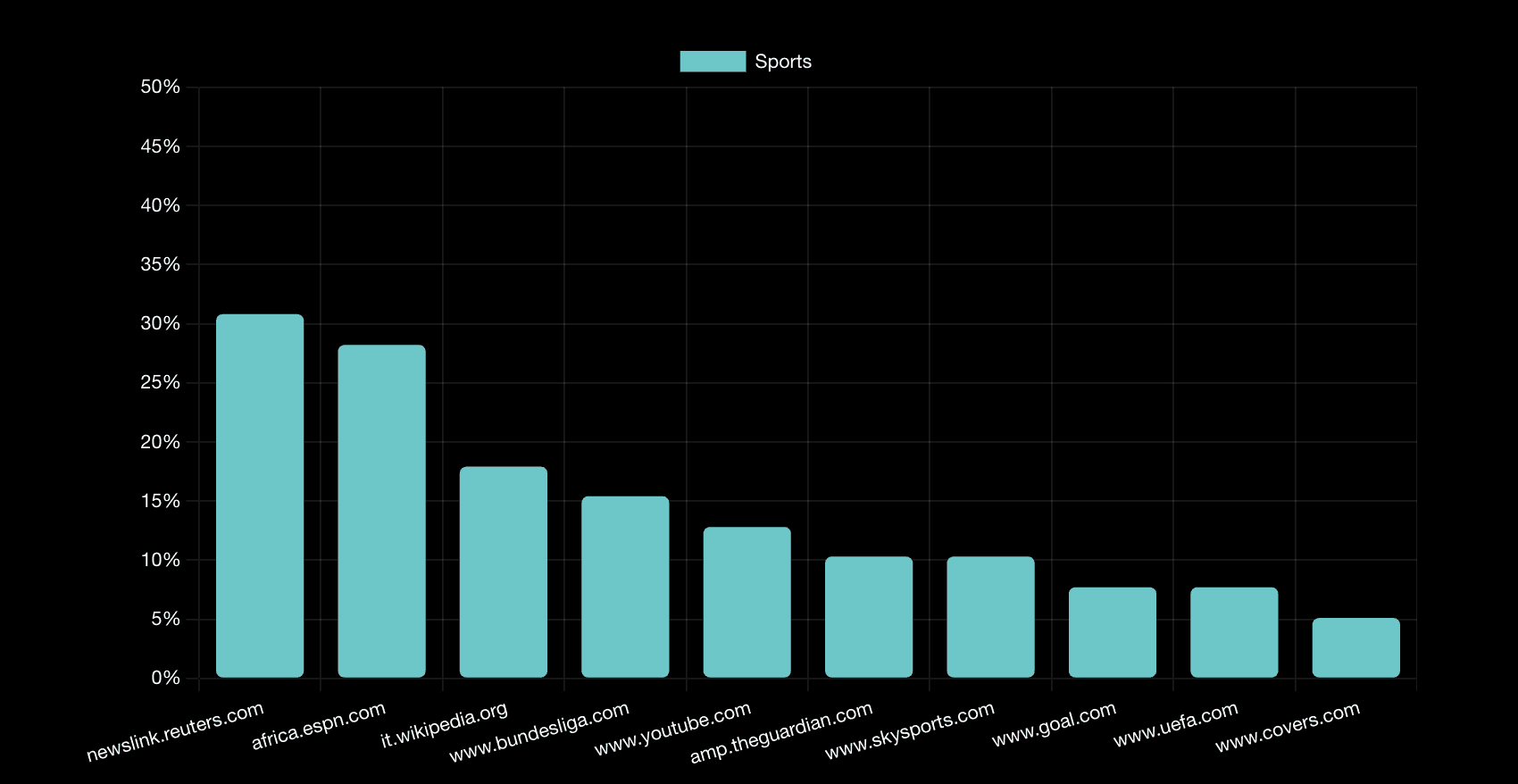
Sports coverage demonstrates geographic and league-specific specialization, with regional sources and official league websites competing alongside international sports media.
Regional and League-Specific Sources Dominate
ESPN leads with 28.2% (↑ from 24.3%), and gaining 4 percentage points.
Reuters maintains 30.8% (↑ from 29.7%), demonstrating wire service relevance for sports news alongside specialized sports media.
Wikipedia captures 17.9% (↓ from 32.4%), representing a substantial 14-percentage-point decline in sports reference citations.
Bundesliga.com reaches 15.4% (↑ from appearing outside top 10), The Guardian shows 10.3% (↑ from previous week), and Sky Sports maintains 10.3% (↑ from 8.1%).
UEFA.com appears at 7.7% (↓ from 13.5%), Goal.com at 7.7% (↑ from 5.4%), and Covers.com at 5.1%, indicating distributed coverage among specialist sports sources, and signals that AI models do not shy away from using betting companies as a source.
YouTube's presence at 12.8% (↓ from 18.9%) shows video content plays a smaller role than previous week, declining 6 percentage points.
Key Takeaway: Sports queries show high geographic and league specialization, with ESPN, UEFA and Bundesliga.com capturing significant shares for region-specific content. Wikipedia's substantial decline suggests AI platforms increasingly cite primary sports sources and official league websites over encyclopedic sports information. The mix of international wire services, regional sports media, and official league sources indicates sports coverage requires diverse source types to address different aspects of sports queries.
Category Analysis: General News & Politics
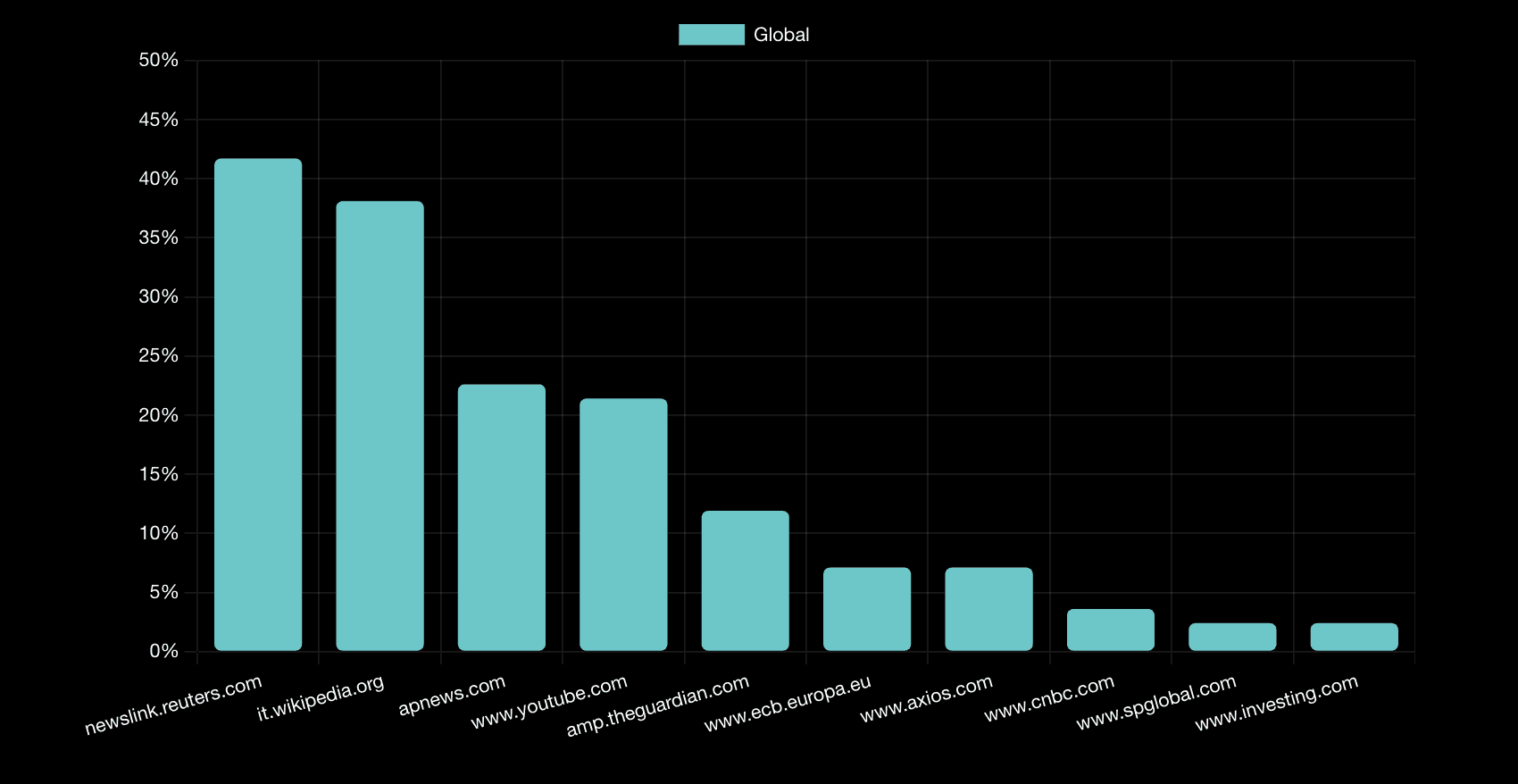
General news and political queries show balanced citation patterns between wire services, reference sources, and multimedia content, with institutional sources playing a supporting role.
Wire Services and Reference Sources Share Leadership
Reuters leads with 41.7% (↑ from 34.1%), gaining 7 percentage points and strengthening its position as the primary news wire.
Wikipedia maintains 38.1% (↓ from 40.2%), showing relatively stable reference source citations compared to its larger declines in other categories.
AP News captures 22.6% (↑ from 14.1%), matching its economics performance and marking substantial growth in general news citations.
YouTube reaches 21.4% (↓ from 24.4%), demonstrating continued multimedia content relevance despite a 3-percentage-point decline.
The Guardian appears at 11.9% (↑ from 8.4%), ECB at 7.1% (unchanged), and Axios at 7.1% (↑ from 4.9%), showing distributed secondary source citations.
Key Takeaway: General news queries demonstrate more balanced citation patterns than specialized categories, with both Reuters and Wikipedia maintaining strong presence above 38%. The substantial increases for Reuters and AP News suggest recent news cycles favored wire service reporting, while Wikipedia's relative stability indicates reference material remains relevant for general information needs. YouTube's presence at 21.4% confirms multimedia content serves general news queries more than specialized topics, though its decline may reflect the specific news topics queried this week.
Regional Analysis: German-Language Queries
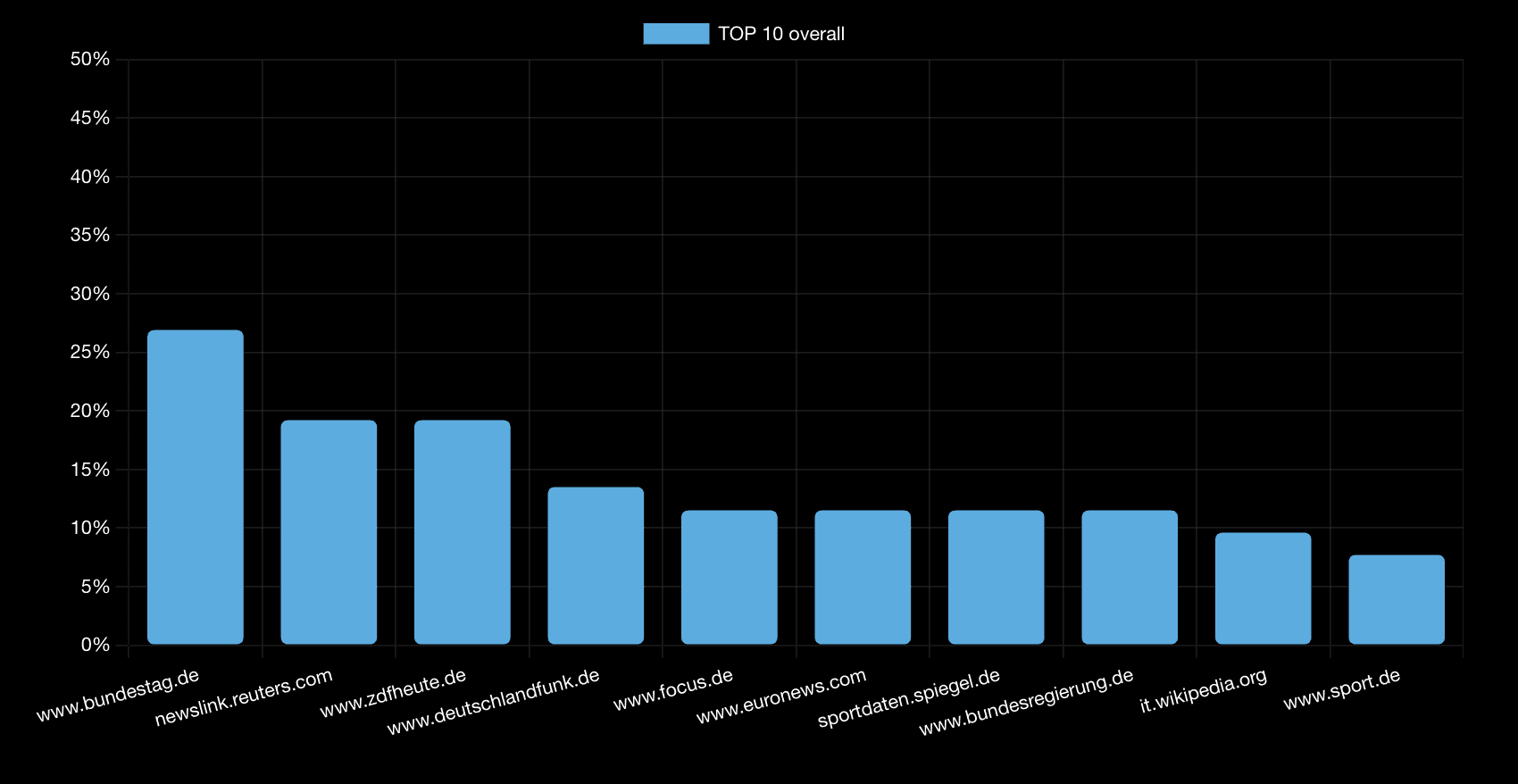
German-language queries reveal distinct patterns emphasizing government sources, public broadcasters, and regional commercial media, with platform-specific preferences creating varied citation landscapes.
Government and Institutional Sources Lead Overall
The official Bundestag website maintains 26.9% (↑ from 25.5%), showing consistent government source authority across platforms with modest growth.
Reuters reaches 19.2% (↑ from 15.7%), ZDF captures 19.2% (↑ from 9.8%), demonstrating substantial 9-percentage-point growth for public broadcasting.
Deutschlandfunk holds 13.5% (↓ from 21.6%), showing an 8-percentage-point decline despite remaining among top sources.
Focus.de appears at 11.5% (appearing in overall top 10 for first time), Euronews at 11.5% (↑ from 5.5%), and Spiegel Sport at 11.5% (↓ from 11.8%).
Bundesregierung maintains 11.5% (↓ from 27.5%), representing a substantial 16-percentage-point decline in overall citations.
Platform-Specific Patterns Show Distinct Preferences
ChatGPT-4 cites ZDF at 22.2% (↑ from 17.6%), Wikipedia at 22.2% (↓ from 17.6%), Bundestag at 27.8% (↑ from 11.8%), showing increased reliance on established institutional sources.
ChatGPT-5 shows Reuters at 50.0% (unchanged from previous week), Euronews at 25.0% (↑ from 3.1%), Bundestag at 25.0% (↑ from 18.8%), demonstrating wire service concentration similar to English queries.
Perplexity leads with ZDF at 33.3% (↑ from 11.1%), Bundestag at 27.8% (↓ from 44.4%), Deutschlandfunk at 27.8% (↓ from 44.4%), Focus at 27.8% (↑ from appearing outside top 10), and Spiegel Sport at 27.8% (↑ from 16.7%).
ECB reaches 7.7% overall (↑ from 5.5%), Sport.de captures 7.7%, and Bundesliga.com appears at 7.7% (↑ from 5.9%), showing sports and institutional source diversity.
Key Takeaway: German-language queries demonstrate stronger reliance on government and public broadcasting sources compared to English queries, with Bundestag consistently cited across all platforms. The substantial variation between platforms, ChatGPT-5's 50% Reuters concentration versus Perplexity's distributed German-language sources, indicates different localization strategies. ZDF's substantial overall increase suggests recent German news cycles favored public broadcasting content, while Bundesregierung's decline despite remaining in top sources may reflect the specific mix of queries this week rather than structural changes in government source authority.
Strategic Implications
Multi-Platform Citation Volatility
Week-over-week data reveals significant citation share fluctuations, with several sources showing movements of 5-15 percentage points. These patterns raise important considerations for publishers:
Reuters increased 8 percentage points in economics (43.3% to 51.6%) and 7 percentage points in general news (34.1% to 41.7%), while AP News jumped into top performers at 22.6% (from 14.1% overall).
Wikipedia declined 7-14 percentage points across most categories, with sports showing the largest drop (32.4% to 17.9%).
German public broadcaster ZDF nearly doubled its overall presence (9.8% to 19.2%), while Bundesregierung declined substantially (27.5% to 11.5%).
Multiple sources entered or exited top 10 rankings between weeks, including TechStartups, Focus.de, and Bundesliga.com gaining prominence.
Key Takeaway: This week's data suggests AI search citation patterns show meaningful volatility across seven-day periods. Publishers should recognize that weekly rankings may reflect current news cycles, algorithm adjustments, or query mix variations rather than stable long-term visibility. Sustained monitoring across multiple weeks will be essential to distinguish temporary fluctuations from meaningful trend shifts. The data indicates publishers should focus on consistent content quality and platform optimization rather than optimizing for specific weekly rankings.
Category Specialization Benefits Vertical Publishers
The data demonstrates clear advantages for specialized publishers in their respective domains, though these patterns vary by category maturity:
Technology vertical shows strongest specialization, with TechCrunch (26.9%), TechStartups (15.4%), and Crunchbase (13.5%) combining for substantial specialized source dominance.
Sports coverage splits between specialist sports media (ESPN Africa 28.2%, Sky Sports 10.3%) and official league sources (Bundesliga 15.4%, UEFA 7.7%).
Economics shows institutional authority, with ECB, IMF, S&P Global, and OECD each capturing 12.9-16.1% alongside commercial financial media.
General news maintains more balanced patterns, with multiple source types competing for visibility without clear specialization advantages.
Key Takeaway: Vertical specialization provides measurable citation advantages in technology and sports coverage, where AI platforms appear to recognize domain expertise. However, economics queries favor institutional sources over commercial specialized publishers, suggesting authority type matters more than commercial specialization. Publishers should evaluate whether their category rewards specialist positioning or institutional credibility when developing AI visibility strategies.
Conclusion
This week's citation data reveals both consistent patterns and notable shifts in AI search source selection. Reuters continues strengthening its wire service position across categories, while Wikipedia shows modest declines suggesting evolving reference vs. primary source dynamics. The substantial week-over-week volatility in several sources indicates publishers should interpret weekly rankings within the context of news cycles and platform adjustments rather than as stable visibility indicators. For publishers navigating this evolving landscape, ALLMO.ai provides ongoing monitoring and analysis to track these patterns across platforms and categories. As AI search platforms continue refining their citation algorithms, understanding these visibility patterns remains essential for publishers seeking to maintain presence in AI-generated responses.
As artificial intelligence search platforms continue to evolve, understanding citation patterns becomes increasingly critical for publishers navigating this new information ecosystem. This week's analysis examines how Reuters, Wikipedia, YouTube, and other major sources perform across ChatGPT-4, ChatGPT-5, and Perplexity, revealing both consistent patterns and notable shifts in source selection behavior.
This analysis draws from ALLMO.ai's comprehensive tracking methodology, which tests AI search platforms using diverse prompts spanning news topics, autocomplete suggestions, and category-specific queries. By examining which sources these platforms cite most frequently, publishers can better understand their visibility in AI-generated responses. See the full data at allmo.ai/trends.
New: For the first time this report also includes week-to-week variations may reflect current news cycles, platform algorithm adjustments, or shifting content availability rather than permanent structural changes in citation behavior. Still the data reflects a limited time period of citation patterns and should be interpreted within that temporal context.
Top 3 Highlights
1. Reuters Increases Dominance in Economics & Finance
Reuters leads economics and finance citations at 51.6% (↑ from 43.3%), maintaining its position as the primary financial news source across AI platforms. This 8-percentage-point increase represents substantial growth in an already dominant position, reflecting the platform's continued reliance on established wire services for economic information.
2. Wikipedia Shows Modest Decline Across Categories
Wikipedia citations decreased to 16.1% in economics (↓ from 23.3%) and 17.9% in sports (↓ from 32.4%), while maintaining 38.1% in general news (↓ from 40.2%). These declines of 7-14 percentage points suggest AI platforms may be shifting toward more specialized primary sources, though Wikipedia remains a significant reference across most categories.
3. Technology Coverage Shows Specialized Source Concentration
TechCrunch maintains strong presence at 26.9% in technology coverage (↑ from 23.1%), while specialist sources including TechStartups (15.4%) and Crunchbase (13.5%) capture substantial citation share. This pattern indicates technology queries favor vertical-specific publishers over general news sources.
Overall Platform Leaders
This section examines the top-cited sources across all platforms and categories, providing insight into which publishers maintain the strongest overall visibility in AI search results.
Reuters and Wikipedia Lead Overall Citations
Reuters captures 51.6% of economics citations, 41.7% in general news, 30.8% in sports, and 23.1% in technology, demonstrating consistent cross-category strength.
Wikipedia shows broad presence with 38.1% in general news, 17.9% in sports, 16.1% in economics, and 9.6% in technology, maintaining its role as a foundational reference source.
YouTube reaches 21.4% in general news citations (↓ from 24.4%), 12.8% in sports (↓ from 18.9%), and 9.7% in economics (↑ from 3.3%), showing category-specific video content preferences.
AP News maintains 22.6% citation rate in both economics and general news (↑ from 14.1% overall), entering the top performers this week with substantial gains.
The Guardian appears at 11.9% in general news citations (↑ from 8.4% overall), increasing its presence among top-cited sources.
Key Takeaway: The data shows Reuters strengthening its position across most categories while Wikipedia experiences moderate declines, particularly in specialized topics. YouTube's presence varies significantly by category, suggesting video content serves specific query types rather than universal information needs. The rise of AP News into top citations indicates week-over-week volatility in secondary news sources, likely reflecting recent news cycles that favor wire service reporting.
Category Analysis: Economics & Finance
Economic and financial queries show distinct citation patterns, with institutional sources and specialized financial publishers commanding significant visibility alongside major news outlets.
Institutional and Wire Service Dominance
Reuters leads with 51.6% (↑ from 43.3%), representing more than half of all top citations in economic queries and showing 8-percentage-point growth.
AP News captures 22.6% (↑ from previous week's absence from top 10), marking a new entry to top performers in this category.
European Central Bank maintains 16.1% (↓ from 20.0%), IMF holds 16.1% (↓ from 20.0%), and S&P Global shows 16.1% (↓ from 20.0%), all demonstrating institutional source authority despite modest declines.
CNBC appears at 12.9%, Investing.com at 12.9%, and OECD at 12.9%, indicating distributed citation patterns among specialized financial sources.
Wikipedia's presence at 16.1% (↓ from 23.3%) represents a 7-percentage-point decline, suggesting reduced reliance on encyclopedia sources for economic information.
Key Takeaway: Economics and finance queries demonstrate high concentration among wire services and institutional sources, with Reuters capturing more than half of top citations. The notable presence of organizations like the ECB, IMF, and OECD indicates AI platforms prioritize authoritative institutional voices for economic data and analysis. The increase in Reuters and AP News, combined with Wikipedia's decline, suggests a shift toward primary news sources over reference material for financial topics this week, though this may reflect recent economic news cycles rather than permanent pattern changes.
Category Analysis: Start-ups & Technology
Technology and startup coverage reveals strong specialization dynamics, with vertical-specific publishers capturing substantial citation share alongside general business sources.
Specialist Technology Publishers Lead
TechCrunch dominates with 26.9% (↑ from 23.1%), maintaining its position as the leading technology news source and showing continued growth.
Reuters captures 23.1% (↑ from 21.2%), demonstrating wire service relevance even in specialized technology coverage.
TechStartups reaches 15.4%, representing a new entry to top performers this week, while Crunchbase maintains 13.5% (↑ from 11.5%).
Forbes shows 9.6% (unchanged from previous week), Wikipedia at 9.6% (unchanged), and Axios at 7.7% (↓ from 9.6%), indicating distributed secondary source citations.
PR Newswire appears at 7.7%, reflecting the role of press releases in startup coverage, while Hypepotamus captures 5.8% as a regional technology source.
Key Takeaway: Technology queries favor specialized vertical publishers, with TechCrunch capturing more than a quarter of top citations. The presence of multiple startup-focused sources (TechStartups, Crunchbase) alongside general business publishers suggests AI platforms recognize technology coverage requires domain expertise. The relatively lower presence of Wikipedia (9.6%) compared to general news (38.1%) indicates technology queries prioritize current industry news over reference material.
Category Analysis: Sports
Sports coverage demonstrates geographic and league-specific specialization, with regional sources and official league websites competing alongside international sports media.
Regional and League-Specific Sources Dominate
ESPN leads with 28.2% (↑ from 24.3%), and gaining 4 percentage points.
Reuters maintains 30.8% (↑ from 29.7%), demonstrating wire service relevance for sports news alongside specialized sports media.
Wikipedia captures 17.9% (↓ from 32.4%), representing a substantial 14-percentage-point decline in sports reference citations.
Bundesliga.com reaches 15.4% (↑ from appearing outside top 10), The Guardian shows 10.3% (↑ from previous week), and Sky Sports maintains 10.3% (↑ from 8.1%).
UEFA.com appears at 7.7% (↓ from 13.5%), Goal.com at 7.7% (↑ from 5.4%), and Covers.com at 5.1%, indicating distributed coverage among specialist sports sources, and signals that AI models do not shy away from using betting companies as a source.
YouTube's presence at 12.8% (↓ from 18.9%) shows video content plays a smaller role than previous week, declining 6 percentage points.
Key Takeaway: Sports queries show high geographic and league specialization, with ESPN, UEFA and Bundesliga.com capturing significant shares for region-specific content. Wikipedia's substantial decline suggests AI platforms increasingly cite primary sports sources and official league websites over encyclopedic sports information. The mix of international wire services, regional sports media, and official league sources indicates sports coverage requires diverse source types to address different aspects of sports queries.
Category Analysis: General News & Politics
General news and political queries show balanced citation patterns between wire services, reference sources, and multimedia content, with institutional sources playing a supporting role.
Wire Services and Reference Sources Share Leadership
Reuters leads with 41.7% (↑ from 34.1%), gaining 7 percentage points and strengthening its position as the primary news wire.
Wikipedia maintains 38.1% (↓ from 40.2%), showing relatively stable reference source citations compared to its larger declines in other categories.
AP News captures 22.6% (↑ from 14.1%), matching its economics performance and marking substantial growth in general news citations.
YouTube reaches 21.4% (↓ from 24.4%), demonstrating continued multimedia content relevance despite a 3-percentage-point decline.
The Guardian appears at 11.9% (↑ from 8.4%), ECB at 7.1% (unchanged), and Axios at 7.1% (↑ from 4.9%), showing distributed secondary source citations.
Key Takeaway: General news queries demonstrate more balanced citation patterns than specialized categories, with both Reuters and Wikipedia maintaining strong presence above 38%. The substantial increases for Reuters and AP News suggest recent news cycles favored wire service reporting, while Wikipedia's relative stability indicates reference material remains relevant for general information needs. YouTube's presence at 21.4% confirms multimedia content serves general news queries more than specialized topics, though its decline may reflect the specific news topics queried this week.
Regional Analysis: German-Language Queries
German-language queries reveal distinct patterns emphasizing government sources, public broadcasters, and regional commercial media, with platform-specific preferences creating varied citation landscapes.
Government and Institutional Sources Lead Overall
The official Bundestag website maintains 26.9% (↑ from 25.5%), showing consistent government source authority across platforms with modest growth.
Reuters reaches 19.2% (↑ from 15.7%), ZDF captures 19.2% (↑ from 9.8%), demonstrating substantial 9-percentage-point growth for public broadcasting.
Deutschlandfunk holds 13.5% (↓ from 21.6%), showing an 8-percentage-point decline despite remaining among top sources.
Focus.de appears at 11.5% (appearing in overall top 10 for first time), Euronews at 11.5% (↑ from 5.5%), and Spiegel Sport at 11.5% (↓ from 11.8%).
Bundesregierung maintains 11.5% (↓ from 27.5%), representing a substantial 16-percentage-point decline in overall citations.
Platform-Specific Patterns Show Distinct Preferences
ChatGPT-4 cites ZDF at 22.2% (↑ from 17.6%), Wikipedia at 22.2% (↓ from 17.6%), Bundestag at 27.8% (↑ from 11.8%), showing increased reliance on established institutional sources.
ChatGPT-5 shows Reuters at 50.0% (unchanged from previous week), Euronews at 25.0% (↑ from 3.1%), Bundestag at 25.0% (↑ from 18.8%), demonstrating wire service concentration similar to English queries.
Perplexity leads with ZDF at 33.3% (↑ from 11.1%), Bundestag at 27.8% (↓ from 44.4%), Deutschlandfunk at 27.8% (↓ from 44.4%), Focus at 27.8% (↑ from appearing outside top 10), and Spiegel Sport at 27.8% (↑ from 16.7%).
ECB reaches 7.7% overall (↑ from 5.5%), Sport.de captures 7.7%, and Bundesliga.com appears at 7.7% (↑ from 5.9%), showing sports and institutional source diversity.
Key Takeaway: German-language queries demonstrate stronger reliance on government and public broadcasting sources compared to English queries, with Bundestag consistently cited across all platforms. The substantial variation between platforms, ChatGPT-5's 50% Reuters concentration versus Perplexity's distributed German-language sources, indicates different localization strategies. ZDF's substantial overall increase suggests recent German news cycles favored public broadcasting content, while Bundesregierung's decline despite remaining in top sources may reflect the specific mix of queries this week rather than structural changes in government source authority.
Strategic Implications
Multi-Platform Citation Volatility
Week-over-week data reveals significant citation share fluctuations, with several sources showing movements of 5-15 percentage points. These patterns raise important considerations for publishers:
Reuters increased 8 percentage points in economics (43.3% to 51.6%) and 7 percentage points in general news (34.1% to 41.7%), while AP News jumped into top performers at 22.6% (from 14.1% overall).
Wikipedia declined 7-14 percentage points across most categories, with sports showing the largest drop (32.4% to 17.9%).
German public broadcaster ZDF nearly doubled its overall presence (9.8% to 19.2%), while Bundesregierung declined substantially (27.5% to 11.5%).
Multiple sources entered or exited top 10 rankings between weeks, including TechStartups, Focus.de, and Bundesliga.com gaining prominence.
Key Takeaway: This week's data suggests AI search citation patterns show meaningful volatility across seven-day periods. Publishers should recognize that weekly rankings may reflect current news cycles, algorithm adjustments, or query mix variations rather than stable long-term visibility. Sustained monitoring across multiple weeks will be essential to distinguish temporary fluctuations from meaningful trend shifts. The data indicates publishers should focus on consistent content quality and platform optimization rather than optimizing for specific weekly rankings.
Category Specialization Benefits Vertical Publishers
The data demonstrates clear advantages for specialized publishers in their respective domains, though these patterns vary by category maturity:
Technology vertical shows strongest specialization, with TechCrunch (26.9%), TechStartups (15.4%), and Crunchbase (13.5%) combining for substantial specialized source dominance.
Sports coverage splits between specialist sports media (ESPN Africa 28.2%, Sky Sports 10.3%) and official league sources (Bundesliga 15.4%, UEFA 7.7%).
Economics shows institutional authority, with ECB, IMF, S&P Global, and OECD each capturing 12.9-16.1% alongside commercial financial media.
General news maintains more balanced patterns, with multiple source types competing for visibility without clear specialization advantages.
Key Takeaway: Vertical specialization provides measurable citation advantages in technology and sports coverage, where AI platforms appear to recognize domain expertise. However, economics queries favor institutional sources over commercial specialized publishers, suggesting authority type matters more than commercial specialization. Publishers should evaluate whether their category rewards specialist positioning or institutional credibility when developing AI visibility strategies.
Conclusion
This week's citation data reveals both consistent patterns and notable shifts in AI search source selection. Reuters continues strengthening its wire service position across categories, while Wikipedia shows modest declines suggesting evolving reference vs. primary source dynamics. The substantial week-over-week volatility in several sources indicates publishers should interpret weekly rankings within the context of news cycles and platform adjustments rather than as stable visibility indicators. For publishers navigating this evolving landscape, ALLMO.ai provides ongoing monitoring and analysis to track these patterns across platforms and categories. As AI search platforms continue refining their citation algorithms, understanding these visibility patterns remains essential for publishers seeking to maintain presence in AI-generated responses.
About the author
ALLMO.ai Team
ALLMO.ai helps brands measure and improve their visibility in AI-generated search results like ChatGPT and Perplexity. It provides optimization insights, recommendations to increase your brands visibility, and URL warm-up to get new content crawled and discovered faster.
Check out more articles
Start your AI Search Optimization journey today!
Applied Large Language Model Optimization (ALLMO), also known as GEO/AEO is gaining strong momentum.