AI Search Trends Report - Week 1 of 2026
AI Search Trends Report - Week 1 of 2026
AI search platforms continue to reshape how information is discovered and consumed also in the year 2026. Below are the most important findings from the first week of the year.

ALLMO.ai Team
ALLMO.ai Team
Jan 6, 2026
Jan 6, 2026

AI search platforms continue to reshape how information is discovered and consumed also in the year 2026.
This analysis examines citation patterns across ChatGPT-4, ChatGPT-5, and Perplexity based on ALLMO.ai's ongoing research. The methodology employs diverse prompts spanning news topics, autocomplete suggestions, and category-specific queries to capture how these platforms select and prioritize sources across different contexts. Week-over-week comparisons provide insight into both emerging patterns and the influence of current news cycles on citation behavior.
Explore the full data at allmo.ai/trends
Top 3 Highlights
1. Wikipedia Maintains Strong General News Presence Despite Category Variation
Wikipedia (en.m.wikipedia.org) captures 44.0% of citations in General News & Politics queries, maintaining its position as the leading reference source for this category. However, this represents a decline from combined Wikipedia citations the previous week (wikipedia.org at 23.5% plus en.m.wikipedia.org at higher individual platform rates), suggesting a consolidation around the mobile domain. The reference platform shows more modest presence in specialized categories, with 19.4% in Economics & Finance, 17.6% in Start-ups & Technology, and 28.9% in Sports, indicating that topical queries increasingly favor primary sources over encyclopedic content.
2. Reuters Shows Stability in Cross-Category Performance
Reuters (reuters.com) demonstrates consistent citation rates across categories this week: 29.0% in Economics & Finance, 23.8% in General News & Politics, 13.2% in Sports, and 9.8% in Start-ups & Technology. Compared to the previous week's category performance (25.8%, 24.7%, 12.8%, and 13.7% respectively), the wire service shows stability in news and economics categories with slight redistribution between technology and sports coverage. This pattern reflects Reuters' sustained position as a cross-platform citation leader, particularly for breaking news and financial information.
3. Specialized Technology Publishers Maintain Category Dominance
TechCrunch leads technology-focused citations at 23.5%, unchanged from the previous week's 23.5%, demonstrating consistent performance in its vertical. The technology category continues to show concentration among specialist publishers, with TechCrunch, techstartups.com (11.8%), and Axios (9.8%) capturing the majority of top citations. This specialization pattern stands in contrast to General News & Politics, where citations are more distributed across wire services, multimedia platforms, and reference sources.
Overall Platform Patterns
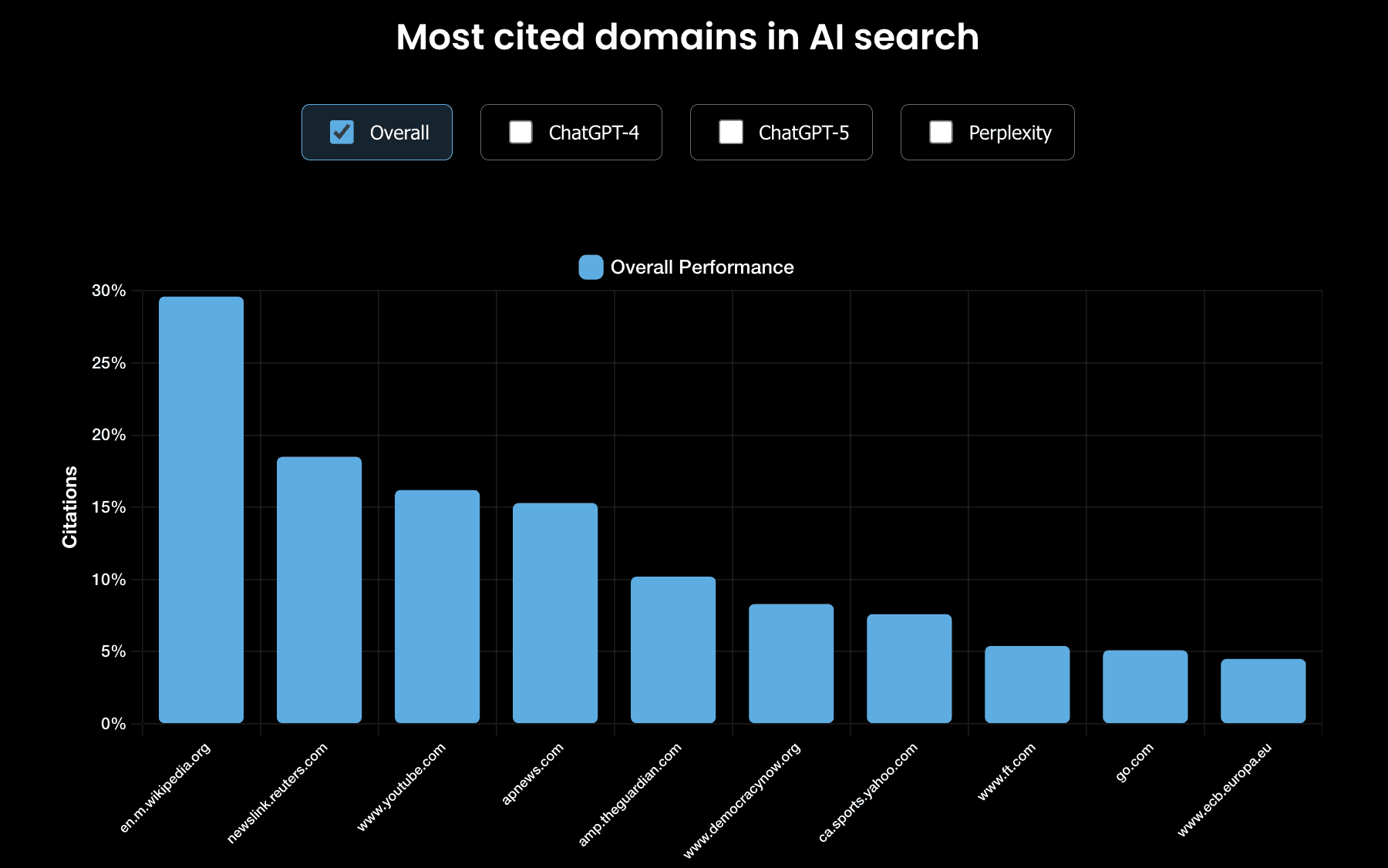
Cross-Platform Leaders
Reuters (newslink.reuters.com) demonstrates strong performance across categories, appearing in 29.0% of Economics & Finance citations, 23.8% of General News & Politics, 13.2% of Sports, and 9.8% of Start-ups & Technology queries, reflecting its wire service breadth and real-time news capabilities.
Wikipedia (en.m.wikipedia.org) captures 44.0% of General News & Politics citations, substantially higher than its presence in Economics & Finance (19.4%), Start-ups & Technology (17.6%), or Sports (28.9%), indicating stronger relevance for general reference queries than specialized business or technology content.
YouTube (www.youtube.com) maintains significant visibility at 26.2% in General News & Politics, with additional presence in Sports (13.2%) and Economics & Finance (9.7%), representing the platforms' willingness to cite multimedia content alongside text-based sources.
AP News (apnews.com) appears prominently in General News & Politics (22.6%) and Economics & Finance (22.6%), showing wire service strength in breaking news and policy coverage, though falling outside the top 10 in Start-ups & Technology.
The Guardian (amp.theguardian.com) maintains presence across General News & Politics (14.3%), Sports (7.9%), and Economics & Finance (3.2%), reflecting its international news focus and multimedia format.
Key Takeaway: The overall landscape shows clear differentiation between general news sources (Reuters, AP News, Wikipedia, YouTube) that maintain broad cross-category presence and specialized publishers that excel within particular verticals. Wire services continue to anchor citation patterns across platforms, while reference sources and multimedia content play significant complementary roles. The stability of top performers week-over-week suggests these patterns reflect longer-term platform preferences rather than transient news cycles.
Category Analysis: Economics & Finance
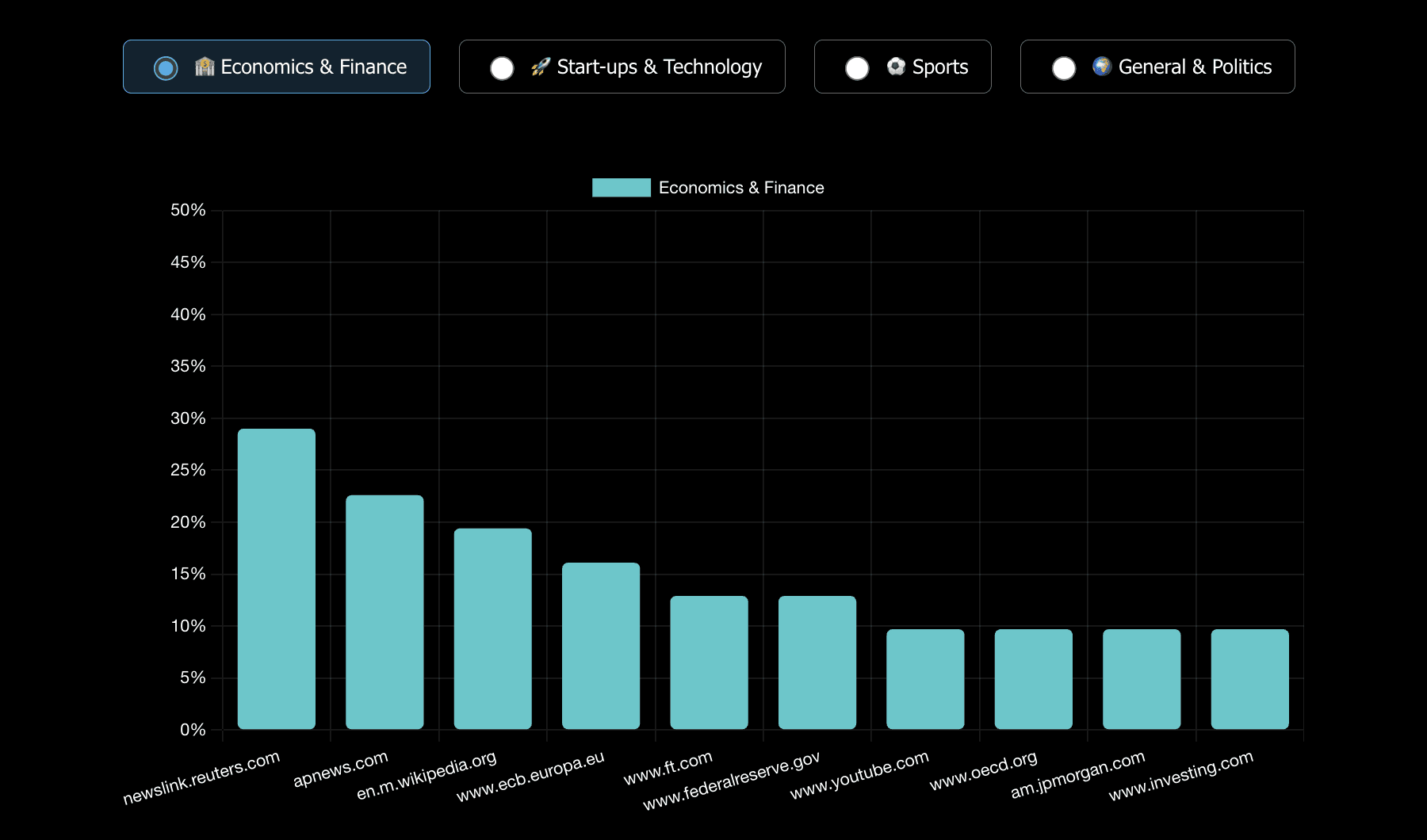
Economics and finance queries reveal a distinct citation hierarchy that balances institutional authority, financial media specialization, and breaking news capabilities. The category shows notable concentration among sources with direct access to economic data and policy information.
Top Sources and Patterns
Reuters leads at 29.0% (↑ from 25.8%), maintaining its position as the primary wire service for financial breaking news and representing roughly 30% increase in citation share, likely reflecting recent economic policy announcements and market volatility coverage.
AP News captures 22.6% (↑ from 19.4%), showing increased presence in financial news coverage and policy reporting alongside its general news strength.
Wikipedia maintains 19.4% (↑ from 9.7% for wikipedia.org), with the shift to en.m.wikipedia.org domain suggesting consolidation around mobile Wikipedia URLs for economic definitions and historical context.
The European Central Bank (www.ecb.europa.eu) appears at 16.1% (↑ from 12.9%), reflecting its institutional authority for monetary policy and eurozone economic data.
Financial Times (www.ft.com) holds 12.9% (unchanged), demonstrating consistent specialist financial journalism visibility.
The Federal Reserve (www.federalreserve.gov) maintains 12.9% (↑ from 9.7%), appearing as a primary source for U.S. monetary policy and economic data.
Institutional financial sources including JPMorgan (am.jpmorgan.com at 9.7%), OECD (www.oecd.org at 9.7%), and Investing.com (www.investing.com at 9.7%) round out the top 10, each capturing roughly 10% of citations.
Key Takeaway: Economics and finance citations show substantial concentration among institutional sources and specialized financial media, with central banks, international organizations, and dedicated financial publishers capturing the majority of top citations. The week-over-week increases for Reuters, AP News, and central bank sources may reflect heightened attention to monetary policy decisions and economic indicators during this measurement period. The presence of both breaking news sources (wire services) and authoritative institutional sources (central banks, OECD) indicates that AI platforms prioritize a combination of timeliness and official data access for economic queries.
Category Analysis: Start-ups & Technology
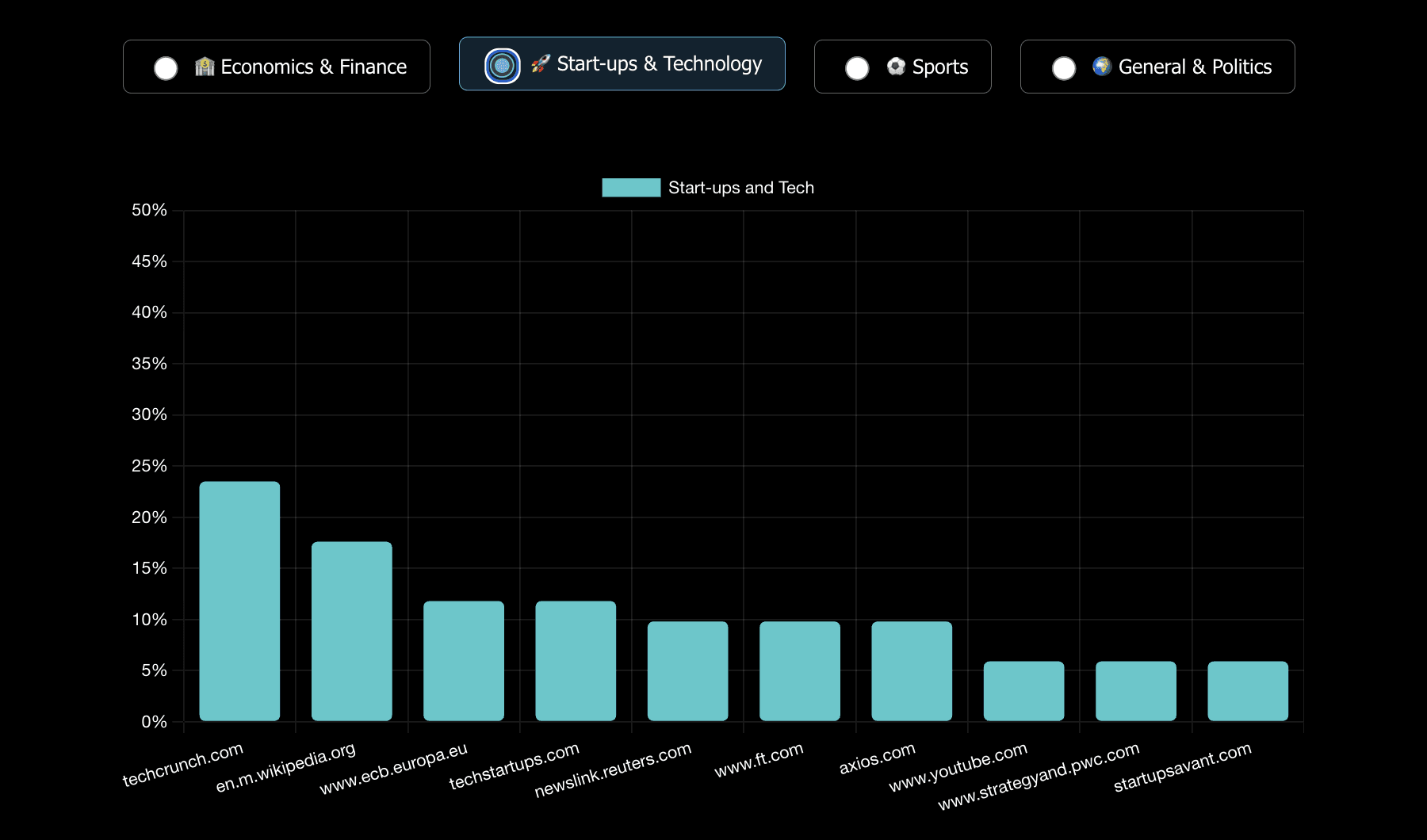
Technology and start-up queries demonstrate the strongest specialization pattern of any category examined, with dedicated technology publishers capturing the majority of top citations. This vertical shows distinct preferences for niche technology media over general news sources.
Top Sources and Patterns
TechCrunch maintains its leading position at 23.5% (unchanged from 23.5%), demonstrating stable dominance as the primary technology news source for start-up coverage and venture capital reporting.
Wikipedia (en.m.wikipedia.org) captures 17.6% (↑ from combined wikipedia.org at 9.8%), serving as reference material for technology company backgrounds and technical definitions.
The European Central Bank (www.ecb.europa.eu) appears at 11.8% (↑ from 9.8%), reflecting cross-category presence in queries that bridge technology and financial topics, such as fintech or economic impacts of technology companies.
Techstartups.com holds 11.8% (unchanged), maintaining its niche focus on startup funding announcements and emerging company coverage.
Reuters drops to 9.8% (↓ from 13.7%), showing reduced visibility in technology-specific queries compared to its general news and finance performance.
Financial Times remains at 9.8% (↑ from 2.0%), indicating increased technology business coverage visibility.
Axios appears at 9.8% (↓ from 11.8%), continuing its position as a technology business news source, though slightly reduced from the previous week.
Specialist sources including Strategy& PwC (www.strategyand.pwc.com at 5.9%) and startupsavant.com (5.9%) capture remaining top citations, demonstrating the category's preference for focused technology and business consulting content.
Key Takeaway: The technology category shows the strongest vertical specialization of any examined segment, with dedicated technology publishers capturing over half of top citations. Wire services show reduced presence compared to their performance in general news or economics, indicating that AI platforms prioritize technology-specific expertise over general breaking news capabilities for these queries. The category's stability week-over-week suggests established hierarchies among technology publishers, with TechCrunch's consistent 23.5% share indicating a clear market leader position for start-up and venture capital coverage.
Category Analysis: Sports
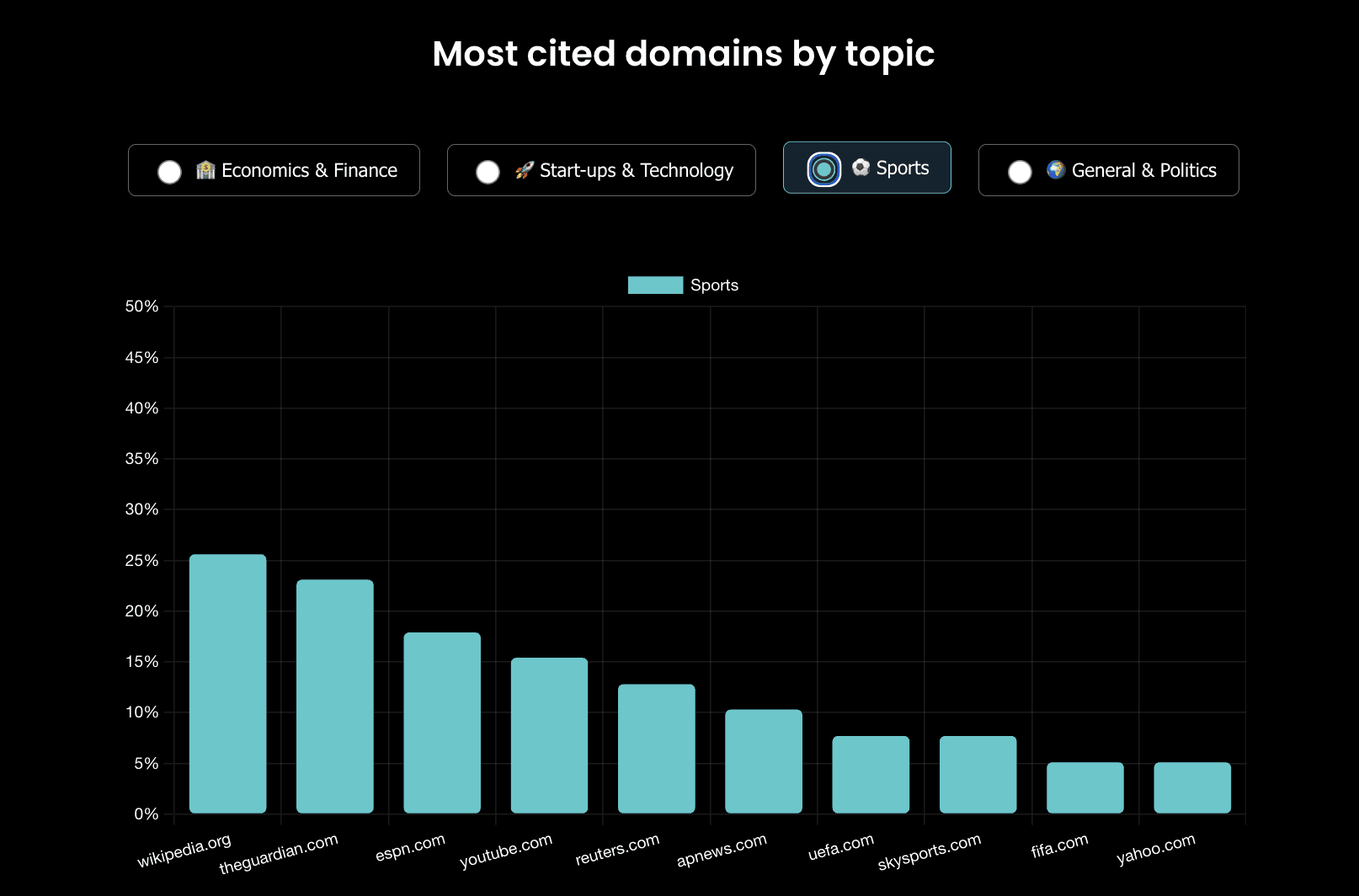
Sports queries reveal a distinctive citation pattern that balances official sports organizations, specialist sports media, and general news sources. The category shows the highest reliance on video content and official league sources compared to other examined verticals.
Top Sources and Patterns
Wikipedia (en.m.wikipedia.org) leads at 28.9% (↑ from 23.1% for wikipedia.org), serving as the primary reference source for player statistics, team histories, and tournament information, representing the category's strongest Wikipedia presence.
Reuters maintains 13.2% (roughly unchanged from 12.8%), providing breaking sports news alongside its broader news coverage.
Fox Sports (www.foxsports.com) and YouTube (www.youtube.com) each capture 13.2%, with YouTube showing substantial increase from 15.4% overall presence, reflecting the importance of video highlights and sports broadcasting in citation patterns.
Yahoo Sports (ca.sports.yahoo.com) appears at 10.5%, providing real-time scores and sports news coverage.
UEFA (www.uefa.com) captures 10.5% (↓ from 12.8%), representing official football governing body presence for European competition information.
ESPN (espn.com) holds 7.9% (↓ from 15.4% for espn.com), showing continued presence from the dominant sports media brand, though with reduced visibility under a specific subdomain.
The Guardian (amp.theguardian.com) maintains 7.9% (↑ from 23.1%), providing international sports journalism coverage.
Specialist sites including footballtransfers.com (5.3%) and Sky Sports (www.skysports.com at 5.3%) round out the top 10, focusing on transfer news and sports broadcasting.
Key Takeaway: Sports citations show the most diverse source mix of any category, combining reference material (Wikipedia), multimedia content (YouTube, Fox Sports), official organizations (UEFA), and specialist sports media. The category's higher Wikipedia citation rate suggests that statistical and historical information plays a larger role in sports queries compared to other verticals. The presence of multiple broadcasting-focused sources (YouTube, Fox Sports, ESPN) indicates that video content maintains stronger citation presence in sports than in news or business categories, likely reflecting the visual nature of sports content consumption.
Category Analysis: General News & Politics
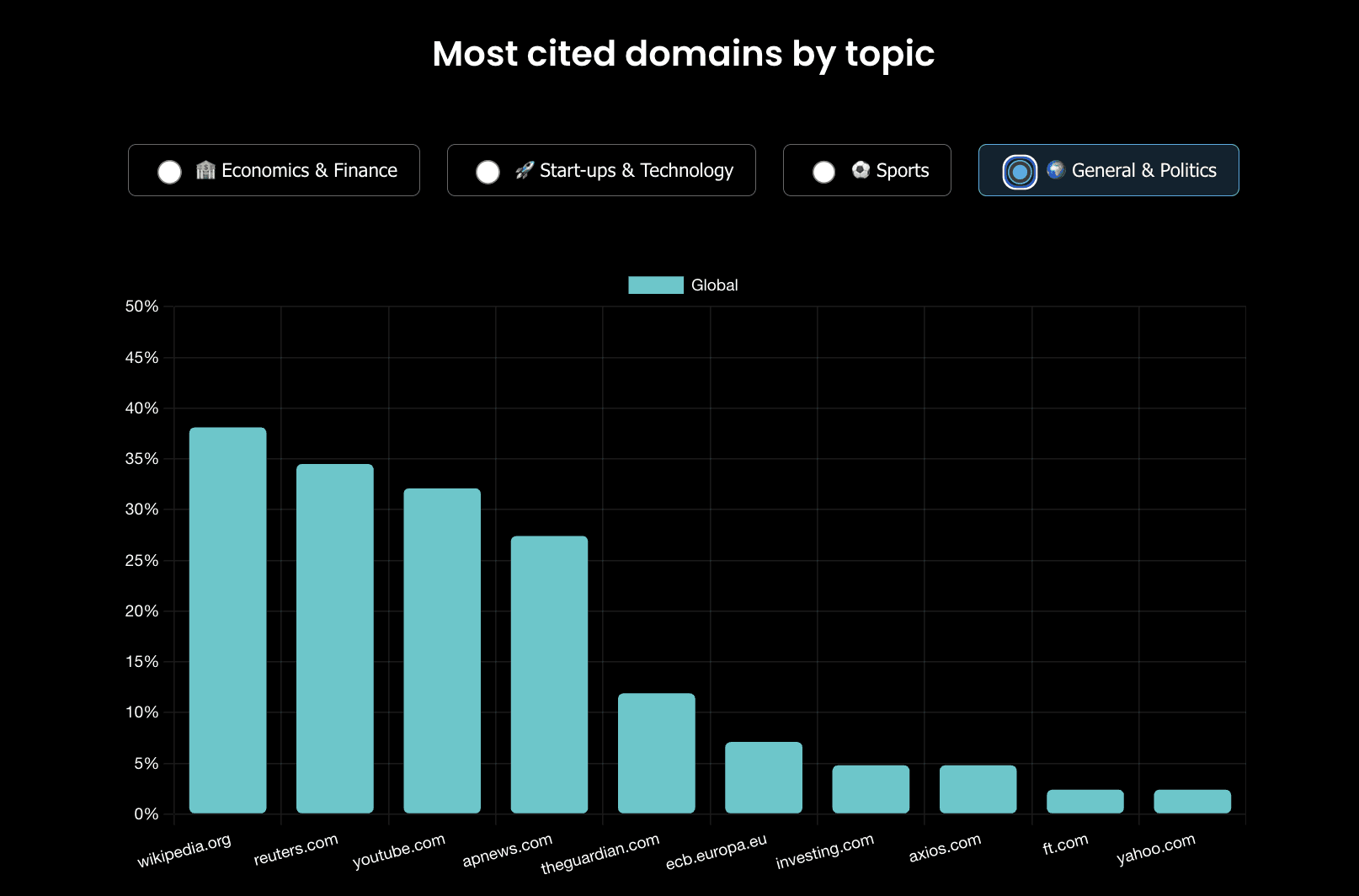
General news and politics queries show the broadest distribution of source types, with strong presence from reference materials, multimedia platforms, wire services, and international news organizations. This category demonstrates the most balanced citation landscape across different publisher types.
Top Sources and Patterns
Wikipedia (en.m.wikipedia.org) captures 44.0% of citations (combined with previous week's wikipedia.org domains totaling approximately 26% overall), representing the category's highest reliance on encyclopedic reference material for political figures, government institutions, and historical context.
YouTube maintains substantial presence at 26.2% (↓ from 31.8%), indicating continued importance of video news content, political speeches, and documentary material in general news queries.
Reuters holds 23.8% (↓ from 24.7%), providing consistent wire service breaking news coverage across international and domestic political developments.
AP News captures 22.6% (roughly unchanged from 27.1%), maintaining its position alongside Reuters as a primary wire service for political and general news coverage.
The Guardian (amp.theguardian.com) appears at 14.3% (↑ from 10.6%), showing increased visibility for international perspective and in-depth political reporting.
Yahoo Sports (ca.sports.yahoo.com) maintains cross-category presence at 8.3%, reflecting Yahoo's general news portal alongside sports coverage.
Financial Times (www.ft.com) captures 6.0% (↑ from 1.2%), indicating business and political economy overlap in general news queries.
Axios appears at 3.6% (↑ from 3.5%), providing concise political news and policy coverage.
The European Central Bank (www.ecb.europa.eu) and Investing.com (www.investing.com) each hold 2.4%, showing limited economic policy presence within general news citations.
Key Takeaway: General news and politics queries show the most distributed citation pattern of any category, with reference material, multimedia content, and multiple wire services all maintaining significant presence. Wikipedia's 44.0% share—substantially higher than any other single source—indicates that general news queries frequently involve biographical, definitional, or contextual information where encyclopedic sources provide foundational context. The combination of traditional wire services (Reuters, AP News) with multimedia platforms (YouTube) and international newspapers (The Guardian) reflects the diverse information needs within political and general news queries, ranging from breaking developments to historical background and visual documentation.
Regional Analysis: German-Language Queries
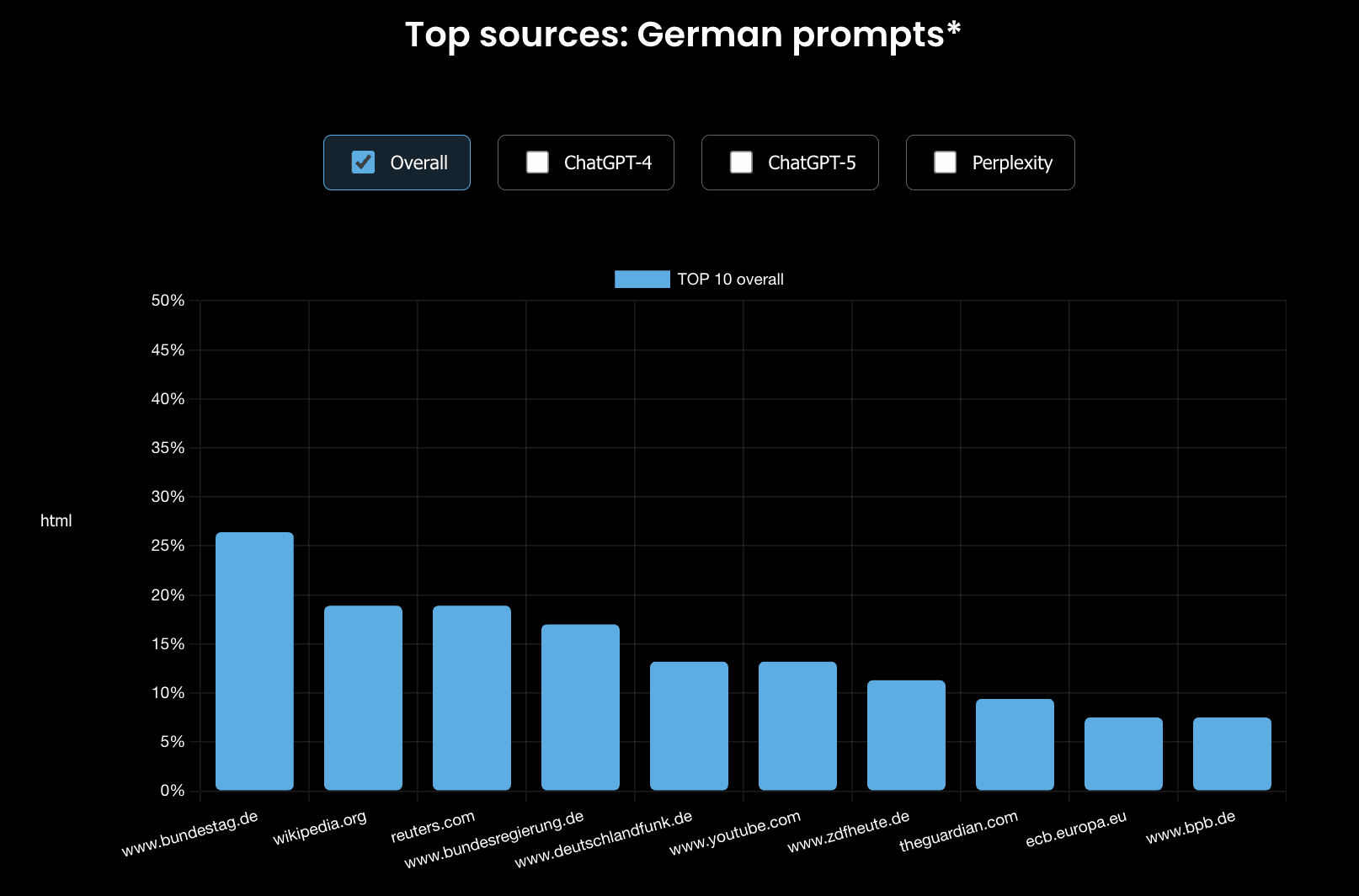
German-language queries reveal markedly different citation patterns compared to English-language results, with substantially higher presence of government and institutional sources alongside public broadcasters. The patterns indicate platform approaches to non-English markets and the role of official sources in different linguistic contexts.
Overall German-Language Patterns
The Bundestag (www.bundestag.de) leads overall German citations at 28.3% (unchanged), representing the German federal parliament and appearing consistently across ChatGPT-4 (17.6% ↑ from 11.8%), ChatGPT-5 (27.8% ↓ from 33.3%), and Perplexity (38.9% unchanged).
Wikipedia (en.m.wikipedia.org) maintains 17.0% overall (↓ from 13.2% for combined Wikipedia domains), with particularly strong ChatGPT-4 presence at 35.3% (↑ from 23.5%), while showing reduced visibility on ChatGPT-5 (5.6%) and Perplexity (11.1%).
Public broadcaster Deutschlandfunk (www.deutschlandfunk.de) captures 17.0% overall (↑ from 9.4%), appearing strongly on Perplexity at 38.9% (↑ from 27.8%) while falling outside ChatGPT-5's top 10.
The Federal Government portal (www.bundesregierung.de) holds 17.0% (unchanged), with consistent presence across platforms: ChatGPT-4 at 5.9% (↓ from 11.8%), ChatGPT-5 at 11.1% (unchanged), and Perplexity at 33.3% (↑ from 27.8%).
Reuters maintains 15.1% (↓ from 18.9%), concentrated entirely within ChatGPT-5 at 44.4% (↓ from 55.6%), while falling outside the top 10 for ChatGPT-4 and Perplexity.
German Commercial Media Performance
Stern (www.stern.de) captures 11.3% overall, with distribution across ChatGPT-4 (11.8%), ChatGPT-5 (5.6%), and Perplexity (16.7%), representing one of the few German commercial news outlets with broad platform visibility.
Spiegel's sports portal (sportdaten.spiegel.de) maintains 11.3% overall (↑ from 7.5%), showing increased presence particularly on Perplexity (27.8% ↑ from 16.7%).
Bundesliga's official site (www.bundesliga.com) holds 9.4%, with strongest presence on ChatGPT-5 (16.7% ↑ from 11.1%).
Süddeutsche Zeitung (www.sueddeutsche.de) and Zeit (www.zeit.de) each capture 7.5% overall, though Zeit shows stronger ChatGPT-4 presence (17.6% ↑ from 11.8%) while falling outside Perplexity's top 10.
YouTube maintains 7.5% overall, exclusively within Perplexity's results at 22.2% (↓ from 33.3%).
Platform-Specific German Citation Characteristics
ChatGPT-4 shows the most balanced distribution between institutional sources (Bundestag at 17.6%) and reference material (Wikipedia at 35.3%), alongside German commercial media (Zeit, Tagesspiegel, Stern all at 11.8%).
ChatGPT-5 demonstrates the highest concentration around Reuters (44.4%) and the Bundestag (27.8%), with reduced presence of German commercial news outlets compared to other platforms.
Perplexity shows strongest preference for German institutional and public broadcasting sources, with Bundestag (38.9%), Deutschlandfunk (38.9%), Bundesregierung (33.3%), and Spiegel sports (27.8%) capturing majority of top citations.
Key Takeaway: German-language queries reveal substantially different citation hierarchies compared to English-language patterns, with government institutions and public broadcasters capturing higher citation shares than commercial news outlets. This pattern may reflect both the authoritative positioning of official German-language sources and potential platform algorithmic preferences for institutional content in non-English markets. The striking contrast between platforms—with Perplexity showing strongest preference for German public institutions while ChatGPT-4 balances commercial and institutional sources—suggests that language market approaches vary significantly across AI search systems. Week-over-week stability in most German sources indicates these patterns represent established preferences rather than news cycle fluctuations.
Conclusion
This week's citation patterns reveal continued platform-specific preferences alongside notable category variations that create distinct visibility landscapes for different publisher types. The persistence of wire services and reference platforms in top citations, combined with strong vertical specialization in technology and sports, indicates that AI search platforms maintain relatively stable hierarchies based on source type, topical authority, and format preferences. The substantial differences between English and German-language results highlight the importance of linguistic market context in understanding AI visibility dynamics. As these platforms continue to evolve, ongoing monitoring through ALLMO.ai's AI Search Trends provides publishers with the data necessary to understand their visibility positioning and adapt their strategies to these emerging distribution channels.
AI search platforms continue to reshape how information is discovered and consumed also in the year 2026.
This analysis examines citation patterns across ChatGPT-4, ChatGPT-5, and Perplexity based on ALLMO.ai's ongoing research. The methodology employs diverse prompts spanning news topics, autocomplete suggestions, and category-specific queries to capture how these platforms select and prioritize sources across different contexts. Week-over-week comparisons provide insight into both emerging patterns and the influence of current news cycles on citation behavior.
Explore the full data at allmo.ai/trends
Top 3 Highlights
1. Wikipedia Maintains Strong General News Presence Despite Category Variation
Wikipedia (en.m.wikipedia.org) captures 44.0% of citations in General News & Politics queries, maintaining its position as the leading reference source for this category. However, this represents a decline from combined Wikipedia citations the previous week (wikipedia.org at 23.5% plus en.m.wikipedia.org at higher individual platform rates), suggesting a consolidation around the mobile domain. The reference platform shows more modest presence in specialized categories, with 19.4% in Economics & Finance, 17.6% in Start-ups & Technology, and 28.9% in Sports, indicating that topical queries increasingly favor primary sources over encyclopedic content.
2. Reuters Shows Stability in Cross-Category Performance
Reuters (reuters.com) demonstrates consistent citation rates across categories this week: 29.0% in Economics & Finance, 23.8% in General News & Politics, 13.2% in Sports, and 9.8% in Start-ups & Technology. Compared to the previous week's category performance (25.8%, 24.7%, 12.8%, and 13.7% respectively), the wire service shows stability in news and economics categories with slight redistribution between technology and sports coverage. This pattern reflects Reuters' sustained position as a cross-platform citation leader, particularly for breaking news and financial information.
3. Specialized Technology Publishers Maintain Category Dominance
TechCrunch leads technology-focused citations at 23.5%, unchanged from the previous week's 23.5%, demonstrating consistent performance in its vertical. The technology category continues to show concentration among specialist publishers, with TechCrunch, techstartups.com (11.8%), and Axios (9.8%) capturing the majority of top citations. This specialization pattern stands in contrast to General News & Politics, where citations are more distributed across wire services, multimedia platforms, and reference sources.
Overall Platform Patterns
Cross-Platform Leaders
Reuters (newslink.reuters.com) demonstrates strong performance across categories, appearing in 29.0% of Economics & Finance citations, 23.8% of General News & Politics, 13.2% of Sports, and 9.8% of Start-ups & Technology queries, reflecting its wire service breadth and real-time news capabilities.
Wikipedia (en.m.wikipedia.org) captures 44.0% of General News & Politics citations, substantially higher than its presence in Economics & Finance (19.4%), Start-ups & Technology (17.6%), or Sports (28.9%), indicating stronger relevance for general reference queries than specialized business or technology content.
YouTube (www.youtube.com) maintains significant visibility at 26.2% in General News & Politics, with additional presence in Sports (13.2%) and Economics & Finance (9.7%), representing the platforms' willingness to cite multimedia content alongside text-based sources.
AP News (apnews.com) appears prominently in General News & Politics (22.6%) and Economics & Finance (22.6%), showing wire service strength in breaking news and policy coverage, though falling outside the top 10 in Start-ups & Technology.
The Guardian (amp.theguardian.com) maintains presence across General News & Politics (14.3%), Sports (7.9%), and Economics & Finance (3.2%), reflecting its international news focus and multimedia format.
Key Takeaway: The overall landscape shows clear differentiation between general news sources (Reuters, AP News, Wikipedia, YouTube) that maintain broad cross-category presence and specialized publishers that excel within particular verticals. Wire services continue to anchor citation patterns across platforms, while reference sources and multimedia content play significant complementary roles. The stability of top performers week-over-week suggests these patterns reflect longer-term platform preferences rather than transient news cycles.
Category Analysis: Economics & Finance
Economics and finance queries reveal a distinct citation hierarchy that balances institutional authority, financial media specialization, and breaking news capabilities. The category shows notable concentration among sources with direct access to economic data and policy information.
Top Sources and Patterns
Reuters leads at 29.0% (↑ from 25.8%), maintaining its position as the primary wire service for financial breaking news and representing roughly 30% increase in citation share, likely reflecting recent economic policy announcements and market volatility coverage.
AP News captures 22.6% (↑ from 19.4%), showing increased presence in financial news coverage and policy reporting alongside its general news strength.
Wikipedia maintains 19.4% (↑ from 9.7% for wikipedia.org), with the shift to en.m.wikipedia.org domain suggesting consolidation around mobile Wikipedia URLs for economic definitions and historical context.
The European Central Bank (www.ecb.europa.eu) appears at 16.1% (↑ from 12.9%), reflecting its institutional authority for monetary policy and eurozone economic data.
Financial Times (www.ft.com) holds 12.9% (unchanged), demonstrating consistent specialist financial journalism visibility.
The Federal Reserve (www.federalreserve.gov) maintains 12.9% (↑ from 9.7%), appearing as a primary source for U.S. monetary policy and economic data.
Institutional financial sources including JPMorgan (am.jpmorgan.com at 9.7%), OECD (www.oecd.org at 9.7%), and Investing.com (www.investing.com at 9.7%) round out the top 10, each capturing roughly 10% of citations.
Key Takeaway: Economics and finance citations show substantial concentration among institutional sources and specialized financial media, with central banks, international organizations, and dedicated financial publishers capturing the majority of top citations. The week-over-week increases for Reuters, AP News, and central bank sources may reflect heightened attention to monetary policy decisions and economic indicators during this measurement period. The presence of both breaking news sources (wire services) and authoritative institutional sources (central banks, OECD) indicates that AI platforms prioritize a combination of timeliness and official data access for economic queries.
Category Analysis: Start-ups & Technology
Technology and start-up queries demonstrate the strongest specialization pattern of any category examined, with dedicated technology publishers capturing the majority of top citations. This vertical shows distinct preferences for niche technology media over general news sources.
Top Sources and Patterns
TechCrunch maintains its leading position at 23.5% (unchanged from 23.5%), demonstrating stable dominance as the primary technology news source for start-up coverage and venture capital reporting.
Wikipedia (en.m.wikipedia.org) captures 17.6% (↑ from combined wikipedia.org at 9.8%), serving as reference material for technology company backgrounds and technical definitions.
The European Central Bank (www.ecb.europa.eu) appears at 11.8% (↑ from 9.8%), reflecting cross-category presence in queries that bridge technology and financial topics, such as fintech or economic impacts of technology companies.
Techstartups.com holds 11.8% (unchanged), maintaining its niche focus on startup funding announcements and emerging company coverage.
Reuters drops to 9.8% (↓ from 13.7%), showing reduced visibility in technology-specific queries compared to its general news and finance performance.
Financial Times remains at 9.8% (↑ from 2.0%), indicating increased technology business coverage visibility.
Axios appears at 9.8% (↓ from 11.8%), continuing its position as a technology business news source, though slightly reduced from the previous week.
Specialist sources including Strategy& PwC (www.strategyand.pwc.com at 5.9%) and startupsavant.com (5.9%) capture remaining top citations, demonstrating the category's preference for focused technology and business consulting content.
Key Takeaway: The technology category shows the strongest vertical specialization of any examined segment, with dedicated technology publishers capturing over half of top citations. Wire services show reduced presence compared to their performance in general news or economics, indicating that AI platforms prioritize technology-specific expertise over general breaking news capabilities for these queries. The category's stability week-over-week suggests established hierarchies among technology publishers, with TechCrunch's consistent 23.5% share indicating a clear market leader position for start-up and venture capital coverage.
Category Analysis: Sports
Sports queries reveal a distinctive citation pattern that balances official sports organizations, specialist sports media, and general news sources. The category shows the highest reliance on video content and official league sources compared to other examined verticals.
Top Sources and Patterns
Wikipedia (en.m.wikipedia.org) leads at 28.9% (↑ from 23.1% for wikipedia.org), serving as the primary reference source for player statistics, team histories, and tournament information, representing the category's strongest Wikipedia presence.
Reuters maintains 13.2% (roughly unchanged from 12.8%), providing breaking sports news alongside its broader news coverage.
Fox Sports (www.foxsports.com) and YouTube (www.youtube.com) each capture 13.2%, with YouTube showing substantial increase from 15.4% overall presence, reflecting the importance of video highlights and sports broadcasting in citation patterns.
Yahoo Sports (ca.sports.yahoo.com) appears at 10.5%, providing real-time scores and sports news coverage.
UEFA (www.uefa.com) captures 10.5% (↓ from 12.8%), representing official football governing body presence for European competition information.
ESPN (espn.com) holds 7.9% (↓ from 15.4% for espn.com), showing continued presence from the dominant sports media brand, though with reduced visibility under a specific subdomain.
The Guardian (amp.theguardian.com) maintains 7.9% (↑ from 23.1%), providing international sports journalism coverage.
Specialist sites including footballtransfers.com (5.3%) and Sky Sports (www.skysports.com at 5.3%) round out the top 10, focusing on transfer news and sports broadcasting.
Key Takeaway: Sports citations show the most diverse source mix of any category, combining reference material (Wikipedia), multimedia content (YouTube, Fox Sports), official organizations (UEFA), and specialist sports media. The category's higher Wikipedia citation rate suggests that statistical and historical information plays a larger role in sports queries compared to other verticals. The presence of multiple broadcasting-focused sources (YouTube, Fox Sports, ESPN) indicates that video content maintains stronger citation presence in sports than in news or business categories, likely reflecting the visual nature of sports content consumption.
Category Analysis: General News & Politics
General news and politics queries show the broadest distribution of source types, with strong presence from reference materials, multimedia platforms, wire services, and international news organizations. This category demonstrates the most balanced citation landscape across different publisher types.
Top Sources and Patterns
Wikipedia (en.m.wikipedia.org) captures 44.0% of citations (combined with previous week's wikipedia.org domains totaling approximately 26% overall), representing the category's highest reliance on encyclopedic reference material for political figures, government institutions, and historical context.
YouTube maintains substantial presence at 26.2% (↓ from 31.8%), indicating continued importance of video news content, political speeches, and documentary material in general news queries.
Reuters holds 23.8% (↓ from 24.7%), providing consistent wire service breaking news coverage across international and domestic political developments.
AP News captures 22.6% (roughly unchanged from 27.1%), maintaining its position alongside Reuters as a primary wire service for political and general news coverage.
The Guardian (amp.theguardian.com) appears at 14.3% (↑ from 10.6%), showing increased visibility for international perspective and in-depth political reporting.
Yahoo Sports (ca.sports.yahoo.com) maintains cross-category presence at 8.3%, reflecting Yahoo's general news portal alongside sports coverage.
Financial Times (www.ft.com) captures 6.0% (↑ from 1.2%), indicating business and political economy overlap in general news queries.
Axios appears at 3.6% (↑ from 3.5%), providing concise political news and policy coverage.
The European Central Bank (www.ecb.europa.eu) and Investing.com (www.investing.com) each hold 2.4%, showing limited economic policy presence within general news citations.
Key Takeaway: General news and politics queries show the most distributed citation pattern of any category, with reference material, multimedia content, and multiple wire services all maintaining significant presence. Wikipedia's 44.0% share—substantially higher than any other single source—indicates that general news queries frequently involve biographical, definitional, or contextual information where encyclopedic sources provide foundational context. The combination of traditional wire services (Reuters, AP News) with multimedia platforms (YouTube) and international newspapers (The Guardian) reflects the diverse information needs within political and general news queries, ranging from breaking developments to historical background and visual documentation.
Regional Analysis: German-Language Queries
German-language queries reveal markedly different citation patterns compared to English-language results, with substantially higher presence of government and institutional sources alongside public broadcasters. The patterns indicate platform approaches to non-English markets and the role of official sources in different linguistic contexts.
Overall German-Language Patterns
The Bundestag (www.bundestag.de) leads overall German citations at 28.3% (unchanged), representing the German federal parliament and appearing consistently across ChatGPT-4 (17.6% ↑ from 11.8%), ChatGPT-5 (27.8% ↓ from 33.3%), and Perplexity (38.9% unchanged).
Wikipedia (en.m.wikipedia.org) maintains 17.0% overall (↓ from 13.2% for combined Wikipedia domains), with particularly strong ChatGPT-4 presence at 35.3% (↑ from 23.5%), while showing reduced visibility on ChatGPT-5 (5.6%) and Perplexity (11.1%).
Public broadcaster Deutschlandfunk (www.deutschlandfunk.de) captures 17.0% overall (↑ from 9.4%), appearing strongly on Perplexity at 38.9% (↑ from 27.8%) while falling outside ChatGPT-5's top 10.
The Federal Government portal (www.bundesregierung.de) holds 17.0% (unchanged), with consistent presence across platforms: ChatGPT-4 at 5.9% (↓ from 11.8%), ChatGPT-5 at 11.1% (unchanged), and Perplexity at 33.3% (↑ from 27.8%).
Reuters maintains 15.1% (↓ from 18.9%), concentrated entirely within ChatGPT-5 at 44.4% (↓ from 55.6%), while falling outside the top 10 for ChatGPT-4 and Perplexity.
German Commercial Media Performance
Stern (www.stern.de) captures 11.3% overall, with distribution across ChatGPT-4 (11.8%), ChatGPT-5 (5.6%), and Perplexity (16.7%), representing one of the few German commercial news outlets with broad platform visibility.
Spiegel's sports portal (sportdaten.spiegel.de) maintains 11.3% overall (↑ from 7.5%), showing increased presence particularly on Perplexity (27.8% ↑ from 16.7%).
Bundesliga's official site (www.bundesliga.com) holds 9.4%, with strongest presence on ChatGPT-5 (16.7% ↑ from 11.1%).
Süddeutsche Zeitung (www.sueddeutsche.de) and Zeit (www.zeit.de) each capture 7.5% overall, though Zeit shows stronger ChatGPT-4 presence (17.6% ↑ from 11.8%) while falling outside Perplexity's top 10.
YouTube maintains 7.5% overall, exclusively within Perplexity's results at 22.2% (↓ from 33.3%).
Platform-Specific German Citation Characteristics
ChatGPT-4 shows the most balanced distribution between institutional sources (Bundestag at 17.6%) and reference material (Wikipedia at 35.3%), alongside German commercial media (Zeit, Tagesspiegel, Stern all at 11.8%).
ChatGPT-5 demonstrates the highest concentration around Reuters (44.4%) and the Bundestag (27.8%), with reduced presence of German commercial news outlets compared to other platforms.
Perplexity shows strongest preference for German institutional and public broadcasting sources, with Bundestag (38.9%), Deutschlandfunk (38.9%), Bundesregierung (33.3%), and Spiegel sports (27.8%) capturing majority of top citations.
Key Takeaway: German-language queries reveal substantially different citation hierarchies compared to English-language patterns, with government institutions and public broadcasters capturing higher citation shares than commercial news outlets. This pattern may reflect both the authoritative positioning of official German-language sources and potential platform algorithmic preferences for institutional content in non-English markets. The striking contrast between platforms—with Perplexity showing strongest preference for German public institutions while ChatGPT-4 balances commercial and institutional sources—suggests that language market approaches vary significantly across AI search systems. Week-over-week stability in most German sources indicates these patterns represent established preferences rather than news cycle fluctuations.
Conclusion
This week's citation patterns reveal continued platform-specific preferences alongside notable category variations that create distinct visibility landscapes for different publisher types. The persistence of wire services and reference platforms in top citations, combined with strong vertical specialization in technology and sports, indicates that AI search platforms maintain relatively stable hierarchies based on source type, topical authority, and format preferences. The substantial differences between English and German-language results highlight the importance of linguistic market context in understanding AI visibility dynamics. As these platforms continue to evolve, ongoing monitoring through ALLMO.ai's AI Search Trends provides publishers with the data necessary to understand their visibility positioning and adapt their strategies to these emerging distribution channels.
About the author
ALLMO.ai Team
ALLMO.ai helps brands measure and improve their visibility in AI-generated search results like ChatGPT and Perplexity. It provides optimization insights, recommendations to increase your brands visibility, and URL warm-up to get new content crawled and discovered faster.
Check out more articles

Start your AI Search Optimization journey today!
Applied Large Language Model Optimization (ALLMO), also known as GEO/AEO is gaining strong momentum.