New: Compare Brand Mention and Citation Density Patterns Across AI Models
New: Compare Brand Mention and Citation Density Patterns Across AI Models
Did you make the cut? ALLMO.ai now shows you how many brands AI models typically mention.

Niclas Aunin
Niclas Aunin
Mar 17, 2026
Mar 17, 2026
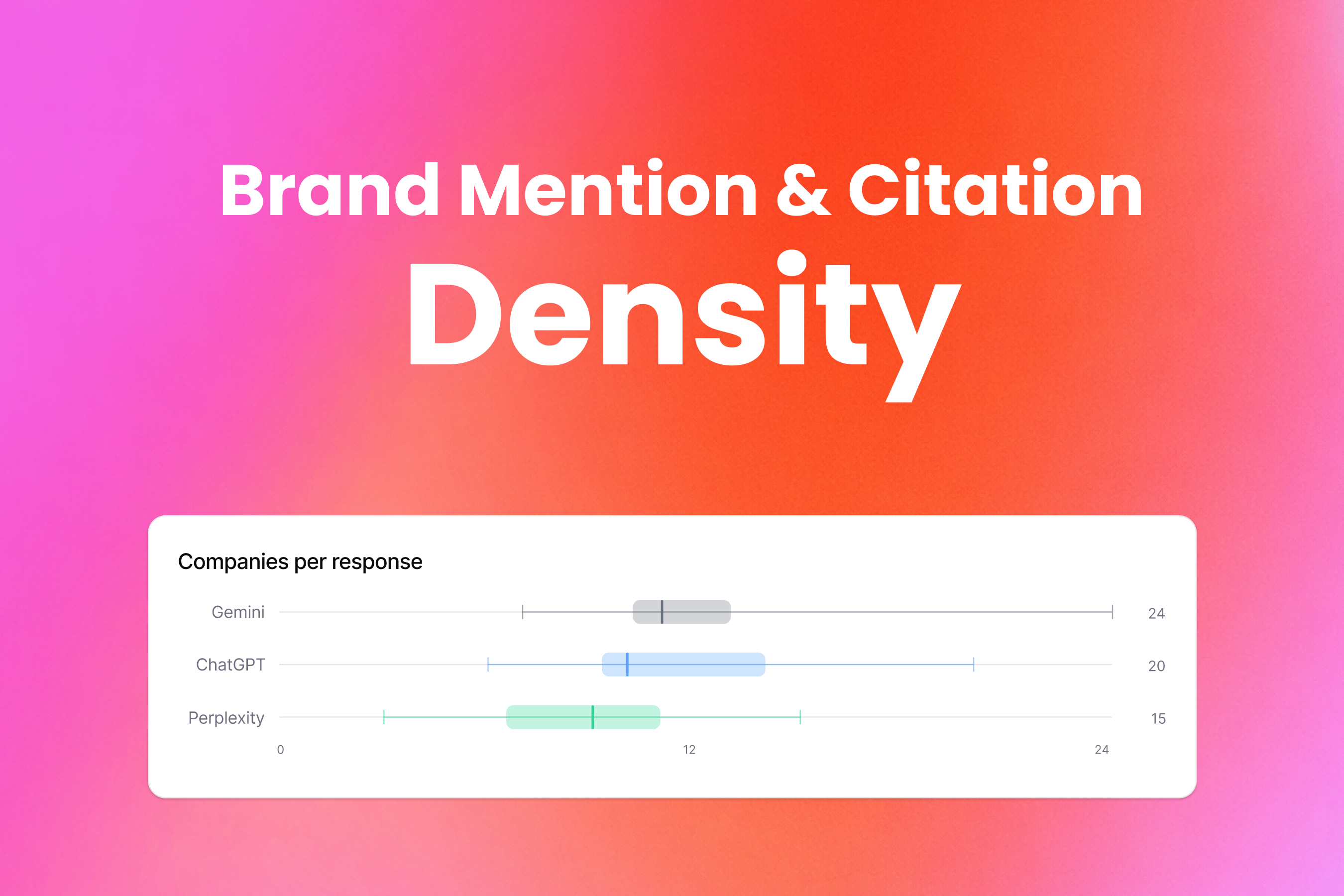
ALLMO.ai now offers even deeper insights into your AI Search Visibility findings. With the new Brand Mention & Citation Density feature on the AI Model Behavior page, you can now reveal patterns how many brands are mentioned, and how many domains are cited in an answer.
How It Works
The new page lives at Explore → Answer Density (/explore/answer-density). It takes the visibility responses from your prompt dataset, groups them by AI model, and visualizes two density metrics side by side:
Brand mention density: how many brands each model surfaces per response, and how consistently.
Citation density: how many domains each model cites per response, and which models cite more or fewer.
For each model, Density shows you a full distribution breakdown (response count, min, max, average, median) in sortable tables, so you can rank models by any stat with one click. Box plots make patterns visual at a glance: a tight box means the model behaves consistently, while a wide spread or outliers signal variability. Select your report, apply filters (language, location, tags, date range, visibility filters), and translate what you see into content updates, optimization efforts, or monitoring priorities.
Why AI Model-Level Behavior Matters
Not all AI models behave the same. Some consistently cite five or more brands per response. Others mention just two or three. That difference has real strategic implications:
Understand competitive density per model. Higher brand mention density means it's easier to get a mention, but there's also more noise. Lower density means it's tougher to break in, but if you do, the visibility is far more valuable. The same pattern holds for citation density. The Density view gives you the data to make these trade-offs strategically, model by model.
Know where you stand, and where you're at risk. If the average response mentions five brands, you need to be in that top five. But what if a model fluctuates, sometimes mentioning you, sometimes not? That inconsistency signals you're sitting right at the cut-off. Making it a great opportunity to boost your visibility. You know exactly where to focus your efforts to move from "sometimes visible" to "consistently visible."
Spot citation gaps before your competitors do. The same logic applies to citation density. If sometimes your page gets cited and sometimes a competitor's page does, the model is uncertain about which source to trust, or sometimes gives more weight to information in one source and sometimes the other. Reverse-engineer what information your competitor's page includes that yours doesn't, then fix it. Close the gap, and the citation will follow.
Both cases have in common that it's usually much easier to boost visibility from 20% to 60% than it is to grow from 0 to 40%.
Strategic Playbook
What you see | What it means | What to do |
|---|---|---|
You're mentioned inconsistently by a model | You're at the cut-off, sometimes in, sometimes out | Optimize content and run targeted warm-ups to lock in consistent mentions |
A model inconsistently cites your URL or a competitor's URL. | The model isn't sure which source to trust, or which data to prioritize | Audit your page vs. theirs and close information gaps. |
A model mentions many brands per response | Easier to get in, but noisier visibility | Good for awareness; prioritize models with fewer mentions for high-value positioning |
A model mentions few brands per response | Harder to break in, but mentions are more valuable | Worth the investment. Focus warm-up and content efforts here |
Wide IQR (box plot spread) for a model | Model behavior is inconsistent | High optimization potential. Understand what factors drive visibility in this area and optimize for those. |
Narrow IQR for a model | Model behavior is stable and predictable | Reliable signal. Use this model's data to benchmark your baseline visibility |
FAQ
Q: Does viewing this page consume credits?
A: No. It analyzes existing visibility responses from your audits and reports. Credits are only consumed when you run new audits or Warm-Up Engine activities.
Q: How do I read the box plots?
A: Each box shows the interquartile range (Q1 to Q3) with a median line. Whiskers extend to min and max values. A narrow box means consistent behavior. A wide box means variable behavior, and that's a clear signal for where optimization matters most.
Q: Why does Density show 0 brand mentions for some models?
A: This can happen with general knowledge prompts that have low commercial intent. If a user asks something like "how does photosynthesis work," AI models often respond without mentioning any brands at all. Check whether your domain is still cited in those responses. If it is, there's an opportunity: positioning your brand more prominently in that content can help you show up as a named mention, not just a source link.
Q: Why does the minimum citation count show 0?
A: AI models don't always trigger a web search when generating a response. If the model's training data and internal knowledge are sufficient to answer a prompt, it may respond without citing any external sources. For these prompts, content optimization is unlikely to move the needle. Focus your efforts on prompts where citations are more likely to appear, such as those related to recent developments, comparative questions, or topics where models need to verify or supplement their knowledge with external sources.
ALLMO.ai now offers even deeper insights into your AI Search Visibility findings. With the new Brand Mention & Citation Density feature on the AI Model Behavior page, you can now reveal patterns how many brands are mentioned, and how many domains are cited in an answer.
How It Works
The new page lives at Explore → Answer Density (/explore/answer-density). It takes the visibility responses from your prompt dataset, groups them by AI model, and visualizes two density metrics side by side:
Brand mention density: how many brands each model surfaces per response, and how consistently.
Citation density: how many domains each model cites per response, and which models cite more or fewer.
For each model, Density shows you a full distribution breakdown (response count, min, max, average, median) in sortable tables, so you can rank models by any stat with one click. Box plots make patterns visual at a glance: a tight box means the model behaves consistently, while a wide spread or outliers signal variability. Select your report, apply filters (language, location, tags, date range, visibility filters), and translate what you see into content updates, optimization efforts, or monitoring priorities.
Why AI Model-Level Behavior Matters
Not all AI models behave the same. Some consistently cite five or more brands per response. Others mention just two or three. That difference has real strategic implications:
Understand competitive density per model. Higher brand mention density means it's easier to get a mention, but there's also more noise. Lower density means it's tougher to break in, but if you do, the visibility is far more valuable. The same pattern holds for citation density. The Density view gives you the data to make these trade-offs strategically, model by model.
Know where you stand, and where you're at risk. If the average response mentions five brands, you need to be in that top five. But what if a model fluctuates, sometimes mentioning you, sometimes not? That inconsistency signals you're sitting right at the cut-off. Making it a great opportunity to boost your visibility. You know exactly where to focus your efforts to move from "sometimes visible" to "consistently visible."
Spot citation gaps before your competitors do. The same logic applies to citation density. If sometimes your page gets cited and sometimes a competitor's page does, the model is uncertain about which source to trust, or sometimes gives more weight to information in one source and sometimes the other. Reverse-engineer what information your competitor's page includes that yours doesn't, then fix it. Close the gap, and the citation will follow.
Both cases have in common that it's usually much easier to boost visibility from 20% to 60% than it is to grow from 0 to 40%.
Strategic Playbook
What you see | What it means | What to do |
|---|---|---|
You're mentioned inconsistently by a model | You're at the cut-off, sometimes in, sometimes out | Optimize content and run targeted warm-ups to lock in consistent mentions |
A model inconsistently cites your URL or a competitor's URL. | The model isn't sure which source to trust, or which data to prioritize | Audit your page vs. theirs and close information gaps. |
A model mentions many brands per response | Easier to get in, but noisier visibility | Good for awareness; prioritize models with fewer mentions for high-value positioning |
A model mentions few brands per response | Harder to break in, but mentions are more valuable | Worth the investment. Focus warm-up and content efforts here |
Wide IQR (box plot spread) for a model | Model behavior is inconsistent | High optimization potential. Understand what factors drive visibility in this area and optimize for those. |
Narrow IQR for a model | Model behavior is stable and predictable | Reliable signal. Use this model's data to benchmark your baseline visibility |
FAQ
Q: Does viewing this page consume credits?
A: No. It analyzes existing visibility responses from your audits and reports. Credits are only consumed when you run new audits or Warm-Up Engine activities.
Q: How do I read the box plots?
A: Each box shows the interquartile range (Q1 to Q3) with a median line. Whiskers extend to min and max values. A narrow box means consistent behavior. A wide box means variable behavior, and that's a clear signal for where optimization matters most.
Q: Why does Density show 0 brand mentions for some models?
A: This can happen with general knowledge prompts that have low commercial intent. If a user asks something like "how does photosynthesis work," AI models often respond without mentioning any brands at all. Check whether your domain is still cited in those responses. If it is, there's an opportunity: positioning your brand more prominently in that content can help you show up as a named mention, not just a source link.
Q: Why does the minimum citation count show 0?
A: AI models don't always trigger a web search when generating a response. If the model's training data and internal knowledge are sufficient to answer a prompt, it may respond without citing any external sources. For these prompts, content optimization is unlikely to move the needle. Focus your efforts on prompts where citations are more likely to appear, such as those related to recent developments, comparative questions, or topics where models need to verify or supplement their knowledge with external sources.
About the author
Niclas Aunin
I’m Niclas, the founder of ALLMO.ai, a platform helping brands measure, analyze and optimize their visibility in AI-generated search results like ChatGPT and Perplexity.
In this blog, I share practical optimization tips, product updates, and learnings from building ALLMO.ai.
Check out more articles
Start your AI Search Optimization journey today!
Applied Large Language Model Optimization (ALLMO), also known as GEO/AEO is gaining strong momentum.