Introducing Co-Mentions: The best way to analyze which competitors appear with you in AI answers.
Introducing Co-Mentions: The best way to analyze which competitors appear with you in AI answers.
Discover which companies AI models mention alongside your brand, ranked by Jaccard, Lift, and co-occurrences; filter by model, date, and tags.

Niclas Aunin
Niclas Aunin
Mar 11, 2026
Mar 11, 2026
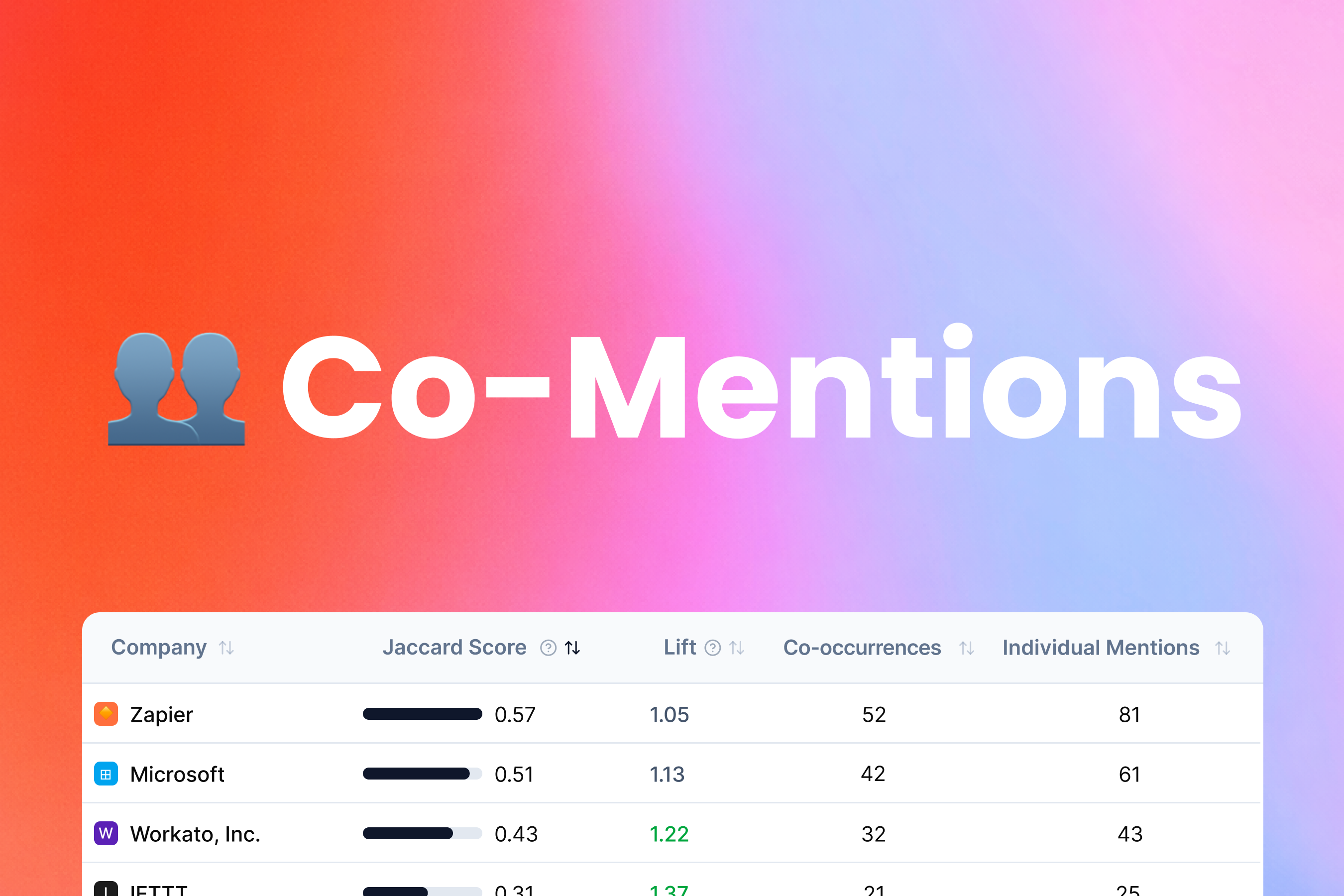
Co-Mentions: See who appears with your brand in AI answers
The new Co-Mentions feature is a great way to understand which other companies AI models are most often mentioned alongside your brand.
The feature analyzes the AI response dataset in your report and identifies companies that appear in the same answers as your brand. It then ranks these relationships using overlap metrics such as Jaccard Score and Lift.
How the ALLMO Co-Mentions Analysis Works
Co-Mentions analyzes your report's AI response dataset and lists other companies mentioned in the same answers as your brand, ranked by overlap metrics including Jaccard Score and Lift. This makes Co-Mentions particularly useful for AI search competitor analysis.
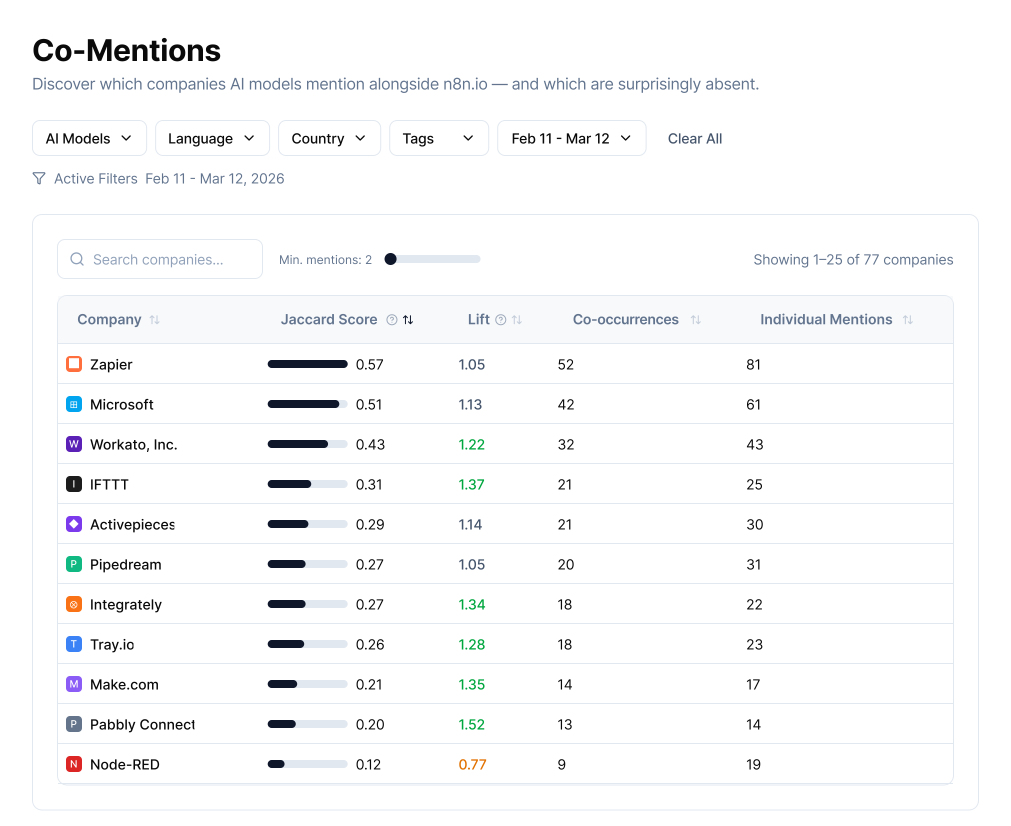
To use Co-Mentions, navigate to Explore and open the report you want to analyze, then select the Co-Mentions tab to load results for your active filters. Use the search box to focus on specific company names, adjust the minimum mentions threshold (1–20) to reduce noise, and sort by Jaccard Score, Lift, co-occurrences, or mentions to prioritize the relationships most relevant to your goals.
Here is an explanation of the metrics:
Jaccard Score: A similarity metric that measures how often two brands appear together relative to their total mentions.
Higher values indicate a stronger topical overlap between the two brands.Lift: Lift measures how much more often two brands appear together than would be expected by chance.
A high lift score indicates a meaningful association in AI responses, even if the absolute number of mentions is smaller.Mentions: The total number of AI responses in the dataset that mention the company.
Co-occurrences: The number of responses where both your brand and the other company appear together.
The Co-Mentions feature respects your report scope and filters, so insights always correspond to the specific model, time period, or segment you are optimizing for.
Why Co-Mentions analysis matters for AI Search
Co-Mention patterns reveal how AI systems position your brand relative to others.
This makes Co-Mentions particularly useful for AI search competitor analysis. By showing which companies AI models mention alongside your brand, you can better understand your competitive landscape in AI generated answers, identify brands that frequently appear in the same recommendation or comparison contexts, and see how strongly those relationships are formed.
This helps you identify:
Identify perceived competitors that frequently appear alongside your brand
Prioritize differentiation against key competitors you appear with often, ensuring your brand stands out in comparison and recommendation answers
Reinforce strong associations with brands that frequently co occur with you, such as partners or ecosystem players
Discover topical neighbors and adjacent companies in the knowledge graph
Identify unexpected brand associations that may reveal opportunities to expand into adjacent categories or use cases
Spot influential brands or sources shaping AI generated answers
A strong Co-Mention relationship usually suggests that AI models see two companies as closely related in the same category, workflow, or decision set.
A weaker than expected relationship can also be meaningful. If you and a known competitor appear together less often than expected, it may indicate that AI models do not consistently recognize you as part of the same competitive set. In practice, this can point to weaker category association, lower brand visibility in key comparison queries, or missing contextual signals that would otherwise place your brand alongside established alternatives.
FAQ
Q: Can I use Co-Mentions for GEO competitor analysis in AI search?
Yes. Co Mentions is a valuable feature for competitor analysis in Answer Engine Optimization (AEO) because it shows which brands AI models mention alongside yours in the same answers.
This helps you understand how AI systems position your brand within your category and which other companies appear in similar recommendation, comparison, or discovery contexts. A strong co mention relationship can highlight close competitors, adjacent players, or brands that share relevant visibility with you in AI search.
Q: Does Co-Mentions require a new audit or consume credits?
Co-Mentions uses the data already collected for the selected report and view. Viewing co-mentions does not trigger a new audit. If you expand the date range or model coverage in a way that requires re-running visibility checks, those audits will consume credits as usual.
Q: How should I set the minimum mentions threshold?
Start at 2–3 to filter single-instance noise; raise toward 10–20 for higher-confidence relationships if your report dataset is large. Use row counts to confirm sample sizes behind metrics.
Co-Mentions: See who appears with your brand in AI answers
The new Co-Mentions feature is a great way to understand which other companies AI models are most often mentioned alongside your brand.
The feature analyzes the AI response dataset in your report and identifies companies that appear in the same answers as your brand. It then ranks these relationships using overlap metrics such as Jaccard Score and Lift.
How the ALLMO Co-Mentions Analysis Works
Co-Mentions analyzes your report's AI response dataset and lists other companies mentioned in the same answers as your brand, ranked by overlap metrics including Jaccard Score and Lift. This makes Co-Mentions particularly useful for AI search competitor analysis.
To use Co-Mentions, navigate to Explore and open the report you want to analyze, then select the Co-Mentions tab to load results for your active filters. Use the search box to focus on specific company names, adjust the minimum mentions threshold (1–20) to reduce noise, and sort by Jaccard Score, Lift, co-occurrences, or mentions to prioritize the relationships most relevant to your goals.
Here is an explanation of the metrics:
Jaccard Score: A similarity metric that measures how often two brands appear together relative to their total mentions.
Higher values indicate a stronger topical overlap between the two brands.Lift: Lift measures how much more often two brands appear together than would be expected by chance.
A high lift score indicates a meaningful association in AI responses, even if the absolute number of mentions is smaller.Mentions: The total number of AI responses in the dataset that mention the company.
Co-occurrences: The number of responses where both your brand and the other company appear together.
The Co-Mentions feature respects your report scope and filters, so insights always correspond to the specific model, time period, or segment you are optimizing for.
Why Co-Mentions analysis matters for AI Search
Co-Mention patterns reveal how AI systems position your brand relative to others.
This makes Co-Mentions particularly useful for AI search competitor analysis. By showing which companies AI models mention alongside your brand, you can better understand your competitive landscape in AI generated answers, identify brands that frequently appear in the same recommendation or comparison contexts, and see how strongly those relationships are formed.
This helps you identify:
Identify perceived competitors that frequently appear alongside your brand
Prioritize differentiation against key competitors you appear with often, ensuring your brand stands out in comparison and recommendation answers
Reinforce strong associations with brands that frequently co occur with you, such as partners or ecosystem players
Discover topical neighbors and adjacent companies in the knowledge graph
Identify unexpected brand associations that may reveal opportunities to expand into adjacent categories or use cases
Spot influential brands or sources shaping AI generated answers
A strong Co-Mention relationship usually suggests that AI models see two companies as closely related in the same category, workflow, or decision set.
A weaker than expected relationship can also be meaningful. If you and a known competitor appear together less often than expected, it may indicate that AI models do not consistently recognize you as part of the same competitive set. In practice, this can point to weaker category association, lower brand visibility in key comparison queries, or missing contextual signals that would otherwise place your brand alongside established alternatives.
FAQ
Q: Can I use Co-Mentions for GEO competitor analysis in AI search?
Yes. Co Mentions is a valuable feature for competitor analysis in Answer Engine Optimization (AEO) because it shows which brands AI models mention alongside yours in the same answers.
This helps you understand how AI systems position your brand within your category and which other companies appear in similar recommendation, comparison, or discovery contexts. A strong co mention relationship can highlight close competitors, adjacent players, or brands that share relevant visibility with you in AI search.
Q: Does Co-Mentions require a new audit or consume credits?
Co-Mentions uses the data already collected for the selected report and view. Viewing co-mentions does not trigger a new audit. If you expand the date range or model coverage in a way that requires re-running visibility checks, those audits will consume credits as usual.
Q: How should I set the minimum mentions threshold?
Start at 2–3 to filter single-instance noise; raise toward 10–20 for higher-confidence relationships if your report dataset is large. Use row counts to confirm sample sizes behind metrics.
Check out more articles
Start your AI Search Optimization journey today!
Applied Large Language Model Optimization (ALLMO), also known as GEO/AEO is gaining strong momentum.